ECU Explained: What Does the Engine Control Unit Actually Do?
In this article
ECU Explained: What Does the Engine Control Unit Actually Do?
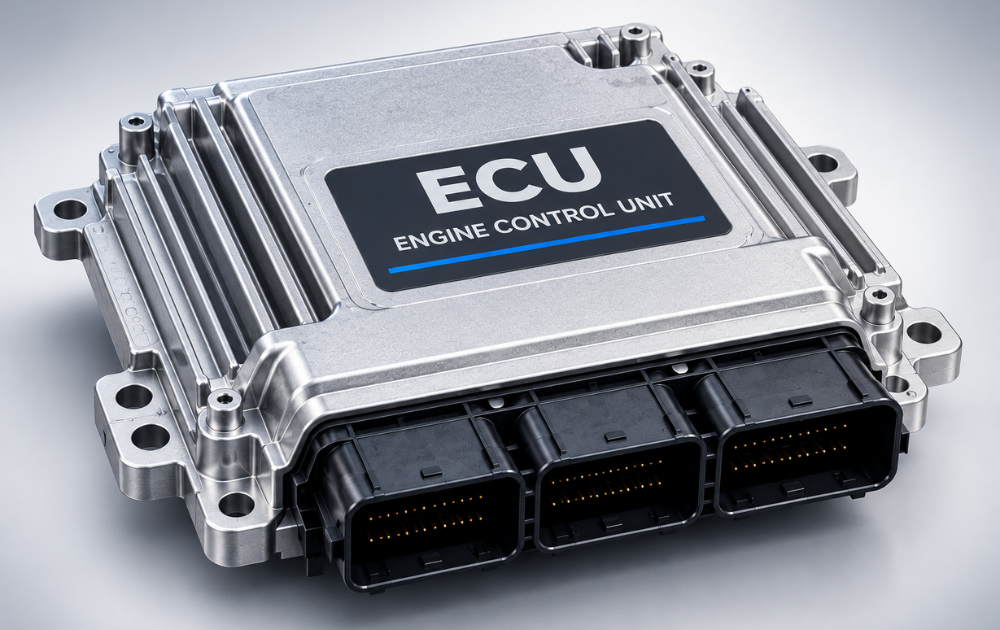
Modern engines depend on electronics to control almost every part of their operation. At the center of this system is the Engine Control Unit (ECU), a computer that continuously monitors engine conditions and adjusts the engine to operate efficiently, reliably, and safely.
But what exactly does the ECU do, and how does it know what the engine needs?
What Is an ECU?
The Engine Control Unit (ECU) is an electronic control computer that manages important engine functions.
It receives information from sensors throughout the vehicle, processes that information using programmed software, and sends commands to different components called actuators.
The basic process is simple:
Sensors → ECU → Actuators
Sensors tell the ECU what is happening. The ECU processes the information and decides what should happen next. Actuators then carry out those commands.
What Does the ECU Control?
The exact functions depend on the vehicle, but an ECU can control several critical engine systems.
Fuel Injection
The ECU determines how much fuel the engine needs and controls the fuel injectors accordingly.
It uses information such as engine speed, engine load, air intake, temperature, and oxygen levels to maintain the appropriate air-fuel mixture.
Ignition Timing
In gasoline engines, the ECU controls when the spark plugs fire.
Correct ignition timing is essential for engine performance, fuel efficiency, and smooth operation. The ECU continuously adjusts timing according to engine speed, load, temperature, and other conditions.
Throttle Control
Modern vehicles often use electronic throttle control.
Instead of a mechanical cable directly connecting the accelerator pedal to the throttle, sensors detect the driver’s accelerator input. The ECU processes this information and controls the throttle electronically.
Variable Valve Timing
Many modern engines use variable valve timing to improve performance, fuel economy, and emissions.
The ECU can adjust valve timing according to engine speed and load, allowing the engine to operate more efficiently under different driving conditions.
Emissions Control
The ECU also manages systems designed to reduce harmful emissions.
It monitors information from oxygen and air-fuel ratio sensors and can control systems such as exhaust gas recirculation and other emissions-related components.
How Does the ECU Receive Information?
The ECU relies on numerous sensors to understand the engine’s condition.
Common examples include:
- Crankshaft position sensor — monitors crankshaft position and speed.
- Camshaft position sensor — provides information about camshaft position.
- Mass airflow sensor (MAF) — measures the amount of air entering the engine.
- Manifold absolute pressure sensor (MAP) — measures pressure inside the intake manifold.
- Engine coolant temperature sensor — monitors engine temperature.
- Throttle position sensor — monitors throttle position.
- Oxygen or air-fuel ratio sensors — provide information about the air-fuel mixture.
- Knock sensor — detects abnormal combustion or engine knock.
The ECU combines information from these sensors to determine how the engine should operate at any given moment.
How Does the ECU Know When Something Is Wrong?
The ECU does more than control the engine. It also continuously monitors the systems connected to it.
When it detects an abnormal condition, it can store a Diagnostic Trouble Code (DTC) and, when appropriate, turn on the Check Engine Light.
For example, if a sensor produces a signal outside the expected range, the ECU may recognize that a fault has occurred and record information about it.
This information can later be accessed using an OBD-II diagnostic scanner.
However, a trouble code does not necessarily mean that the component named in the code is defective.
For example, a code related to an oxygen sensor could be caused by the sensor itself, wiring, an electrical connection, an exhaust problem, or another condition affecting its reading.
A diagnostic code identifies a detected problem, not necessarily the failed component.
This is why proper diagnosis requires more than simply reading and clearing codes.
What Happens When a Sensor Fails?
If a sensor stops working or sends unreliable information, the ECU may use a substitute value or another control strategy to keep the engine running.
Depending on the fault, the vehicle may experience:
- Reduced engine performance
- Poor fuel economy
- Rough running
- Increased emissions
- Difficulty starting
- Warning lights
In more serious situations, the ECU may activate a reduced-performance or limp-home mode to protect the engine or allow the vehicle to reach a safe location.
Does the ECU Work Alone?
No. The ECU is part of a larger electronic system.
Modern vehicles contain multiple control modules that communicate with each other through networks such as the Controller Area Network (CAN bus).
For example, the engine control system may exchange information with the transmission, braking, stability control, instrument cluster, and other modules.
This communication allows different vehicle systems to work together.
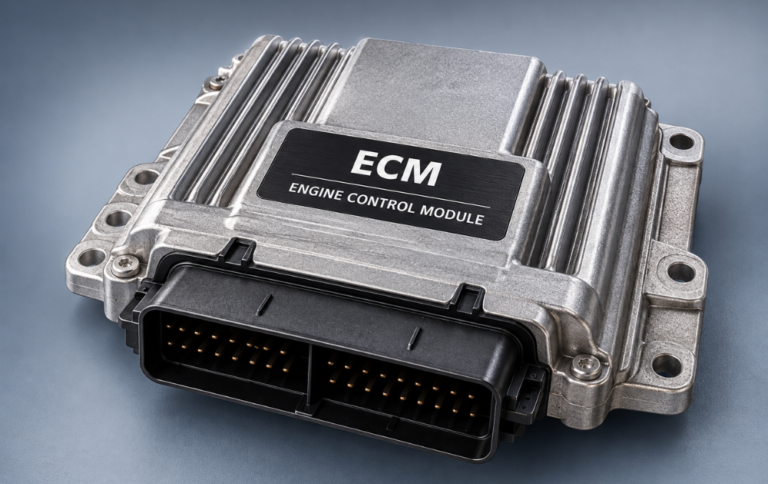
It is also important to understand that ECU, ECM, and other module names can vary between manufacturers. In some vehicles, ECU and ECM may refer to the same engine-control computer, while in others the terminology is used differently.
Can an ECU Be Reprogrammed?
Yes. An ECU contains software and calibration data that determine how the engine responds to different conditions.
Manufacturers can update this software to improve performance, drivability, fuel efficiency, emissions, diagnostics, or compatibility with other vehicle systems.
ECU software can also be modified for performance tuning, but incorrect calibration can cause poor operation, increased emissions, or mechanical damage.
ECU vs. Other Vehicle Control Modules
The ECU is primarily associated with engine management, but it is only one of many electronic control modules found in a modern vehicle.
For example:
- ECU/ECM — manages engine-related functions.
- TCM — manages the transmission.
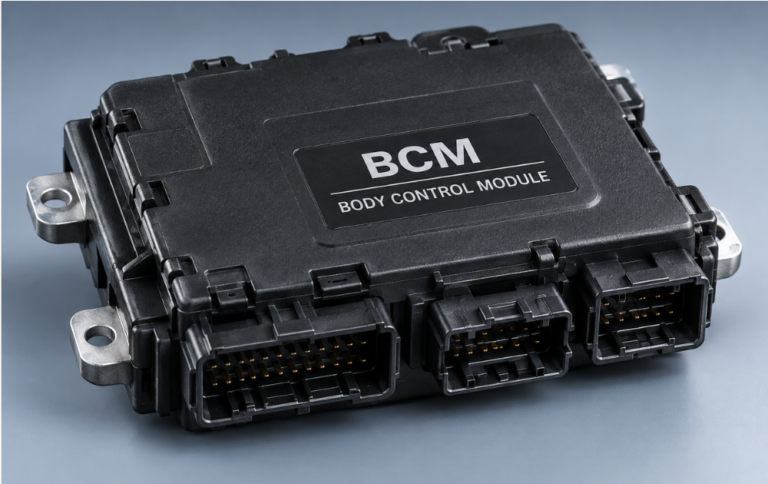
- BCM — manages many body and comfort electrical functions.
- ABS/ESC module — manages braking and vehicle stability systems.
- Airbag control module — manages the vehicle’s restraint system.
These modules communicate with each other to coordinate the vehicle’s different systems.
Why Is the ECU Important?
The ECU is essentially the decision-making center of the engine’s electronic control system.
Without it, modern engine management systems could not precisely coordinate fuel delivery, ignition, throttle operation, emissions control, and many other functions.
More importantly, the ECU provides valuable diagnostic information when something goes wrong. Understanding how it receives information, processes it, and controls different components is therefore essential for anyone learning about modern automotive diagnostics.



2 Comments
Comments are closed.