Airbag System Explained: How It Works, Common Faults, and New Technologies in 2026
In this article
Airbag System Explained: How It Works, Common Faults, and New Technologies in 2026
Introduction
When a car is involved in a serious collision, every millisecond matters. The airbag system is one of the most important safety features designed to help protect the driver and passengers during an accident.
Modern airbag systems are more advanced than many people realize. They use sensors, electronic control units, and specially designed inflators to respond to certain types of collisions. New developments are also making airbags more adaptable to different occupants, seating positions, and crash situations.
For automotive technicians, mechanics, and car owners, understanding this system is essential. It helps explain how vehicle safety works, why an SRS warning light should never be ignored, and how modern airbag technology is changing.
In this guide, we will explore the main components of an airbag system, explain how it operates, examine common faults, and look at important airbag technologies available or under development in 2026.
1. What Is an Airbag System?
An airbag system is a vehicle safety system designed to reduce the risk of injury during certain collisions. It is also known as the Supplemental Restraint System (SRS).
Its primary function is to work alongside seat belts to help protect vehicle occupants. When a collision meets the system’s deployment conditions, one or more airbags may inflate within milliseconds.
The inflated cushion creates a protective surface between the occupant and parts of the vehicle, such as the steering wheel, dashboard, doors, or windows. This helps manage the occupant’s movement and reduce the risk of serious injuries.
However, airbags do not replace seat belts. They are designed to work together with them. Wearing a seat belt correctly and maintaining a suitable seating position are essential for effective protection.
2. Main Components of an Airbag System
An airbag system contains several components that work together to detect a collision and provide protection.
2.1. Crash Sensors
Crash sensors detect rapid changes in vehicle movement associated with a collision. Depending on the vehicle design, sensors may be installed in different locations.
They send information to the airbag control unit, helping the system evaluate the collision and determine whether deployment is necessary.
2.2. Airbag Control Unit (ACU)
The Airbag Control Unit is the electronic brain of the system. It processes information from the sensors and determines whether the conditions for deploying specific airbags have been met.
Depending on the vehicle, it may also control seat belt pretensioners and communicate with other safety systems.
2.3. Airbag Module
The airbag module contains a folded fabric cushion and an inflator. When the system activates the inflator, gas rapidly fills the cushion.
The inflated airbag helps cushion the occupant’s movement during a collision. It then releases gas through designed openings, allowing it to absorb energy.
2.4. Seat Belt Pretensioners
Seat belt pretensioners tighten the seat belt rapidly during certain collisions. This helps reduce excessive movement and keeps the occupant better positioned within the restraint system.
They work together with airbags to improve protection.
2.5. Wiring and Electrical Connectors
Wiring and electrical connectors carry signals between the system’s components. A damaged wire, poor connection, or electrical fault can affect system operation.
Because these circuits contain safety-critical components, inspection and repair must follow the vehicle manufacturer’s procedures.
2.6. SRS Warning Light
The SRS warning light is located on the dashboard. It normally illuminates briefly when the vehicle starts while the system performs its initial check.
If the light remains on or comes on while driving, the system may have detected a fault that requires professional diagnosis.
Important: An illuminated SRS warning light should never be ignored. Depending on the fault, some or all of the system’s protective functions may be affected.
3. How Does an Airbag System Work?
An airbag system follows a series of carefully controlled steps. Each component has a specific role in detecting a collision and providing protection.
Step-by-Step Explanation
Step 1: Collision detection
The vehicle experiences an impact that causes a sudden change in movement.
Step 2: Sensor signals
The crash sensors detect relevant changes and send information to the airbag control unit.
Step 3: Data analysis
The control unit evaluates the available information to determine whether the collision meets the conditions for deploying one or more airbags.
Step 4: Airbag deployment
If deployment is required, the control unit activates the appropriate inflator. Gas rapidly fills the airbag cushion.
Step 5: Impact management
The airbag provides a cushioning surface that helps manage the occupant’s movement and reduce the risk of striking hard surfaces inside the vehicle. The cushion then releases gas through designed openings.
The entire process takes place extremely quickly. However, an airbag does not deploy in every accident. Its activation depends on the type and severity of the collision, the sensor signals, and the vehicle’s safety-system design.
4. Types of Airbags Used in Modern Vehicles
Different airbags are designed to protect different parts of the body.
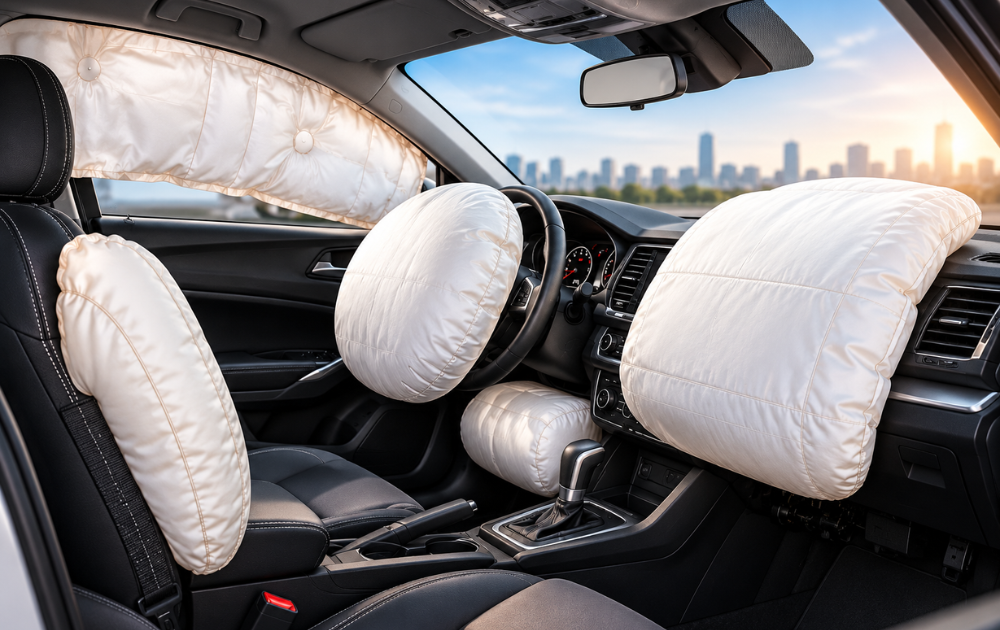
Frontal Airbags
Frontal airbags are usually installed in the steering wheel and dashboard. They help protect the head and upper body during certain frontal collisions.
Side Airbags
Side airbags are commonly installed in seats or doors. They help protect the chest and pelvis during certain side impacts.
Curtain Airbags
Curtain airbags deploy along the side windows to help protect occupants’ heads during certain side collisions. Some systems are also designed to provide protection during rollovers.
Knee Airbags
Knee airbags are installed in the lower dashboard area. They are designed to help manage lower-body movement during certain collisions.
Center Airbags
Center airbags deploy between the driver and front passenger during certain collisions. They help reduce the risk of the occupants striking each other.
Rear-Seat Airbags
Some vehicles include additional airbags designed to improve protection for rear-seat occupants.
The number and type of airbags depend on the vehicle model, its equipment level, and the market in which it is sold.
5. The Latest Airbag Technologies in 2026
Airbag technology continues to evolve. Engineers are working to improve how restraint systems respond to different collisions and protect occupants of different sizes and seating positions.
Some of these technologies are already available in selected production vehicles. Others remain advanced concepts or are being developed for future models.
5.1. Intelligent Occupant Detection and Adaptive Restraints
One important area of development is the integration of occupant-monitoring technology with advanced restraint systems.
These systems can use cameras, seat sensors, seat belt sensors, and software to gather information about an occupant’s position and seating posture.
For example, an occupant sitting close to the dashboard may require a different restraint strategy from someone sitting in a normal position.
The aim is to improve how airbags and seat belts respond to different occupants and crash conditions. However, the available functions depend on the vehicle’s equipment and system design.
5.2. Multi-Chamber Airbags
Traditional airbags generally use one main cushion. Multi-chamber designs divide the cushion into separate sections to improve support in certain collision situations.
For example, some passenger airbag designs use a central section and side sections to help support the head during angled frontal impacts.
This is important because an occupant’s head may move sideways during an oblique collision and slide away from a conventional airbag.
Multi-chamber designs aim to improve head support and manage occupant movement more effectively. Their actual performance depends on the complete restraint system and the circumstances of the collision.
5.3. Center Airbags for Side-Impact Protection
Center airbags are designed to deploy between the driver and front passenger during certain side collisions.
In a far-side impact, an occupant may move across the cabin toward the other front seat. A center airbag provides an additional barrier that can help reduce contact between the occupants.
This technology is already available in selected production vehicles and demonstrates how modern restraint systems are expanding beyond traditional frontal protection.
5.4. Active Heel Airbags and Protection for Reclined Seating Positions
Vehicle interiors are changing as manufacturers explore more flexible seating arrangements, including highly reclined passenger positions.
These new seating configurations create additional safety challenges because the occupant’s body may move differently during a collision.
Emerging airbag concepts can combine several components:
- Seat-Ramp Airbag: Designed to help control forward movement of the pelvis.
- Active Heel Airbag: Intended to help manage foot and lower-leg movement.
- Advanced Knee Airbag: Designed to improve lower-body protection.
- Adaptive Upper-Body Airbag: Intended to provide better protection for the head and upper body in different seating positions.
Together, these concepts aim to manage occupant movement and reduce the risk of submarining. This occurs when the body slides underneath the lap portion of the seat belt during a collision.
These technologies remain under development or are intended for selected future applications. They should not be described as standard equipment in all modern cars.
5.5. External Airbags for Pedestrian Protection
Most airbags are installed inside the vehicle. External airbags take a different approach by deploying outside the vehicle during specific pedestrian-impact situations.
Some systems are designed to create a softer surface near the hood or windshield, helping reduce the risk of head injuries when a pedestrian strikes the vehicle.
Other specialized designs aim to provide protection for cyclists.
External airbags remain limited to particular applications. Their availability depends on the manufacturer and vehicle model.
5.6. More Efficient Airbag Inflation
Another area of development focuses on improving how airbags are inflated.
Some advanced designs use principles of fluid dynamics to draw surrounding air into the cushion during inflation. This approach aims to make it possible to inflate larger cushions more efficiently.
Such developments may be useful in vehicles with changing cabin layouts, including electric vehicles, where manufacturers may need to reconsider airbag size and positioning.
The benefits and availability of these systems depend on the specific design and manufacturer.
6. Common Airbag System Faults
Airbag systems are safety-critical, so any suspected fault should be taken seriously.
| Fault | Possible Cause |
|---|---|
| SRS warning light remains on | The system has detected a fault. |
| Crash sensor fault | A damaged sensor, wiring issue, or poor connection. |
| Pretensioner fault | A problem with the pretensioner or its electrical circuit. |
| Electrical circuit fault | Damaged wiring, a poor connection, or another circuit problem. |
| Airbag control unit fault | An internal module problem or recorded crash data requiring specific procedures. |
| Airbag deployed after a collision | Deployed airbags and related components may require replacement and inspection. |
These are possible causes, not definitive diagnoses. A fault code identifies a condition detected by the system, but it does not always identify the exact component that needs replacement.
For example, an electrical fault may be caused by wiring or a connector rather than the airbag itself.
Replacing parts without confirming the cause can increase repair costs and leave the safety system in an unsafe condition.
7. How to Diagnose an Airbag System
Professional diagnosis should follow a structured process.
Step 1: Check the SRS Warning Light
Observe whether the warning light completes its normal self-check or remains illuminated.
Step 2: Connect a Compatible Diagnostic Tool
Use a diagnostic scanner that supports the vehicle’s SRS system. A basic engine-code reader may not be able to access airbag faults.
Step 3: Read and Record the Fault Codes
Record the diagnostic trouble codes and relevant information before attempting repairs. Consult the vehicle manufacturer’s service documentation to understand the meaning of each code.
Step 4: Follow the Manufacturer’s Diagnostic Procedure
Inspect the relevant components and electrical connections only as instructed in the service manual.
Do not assume that the component named in a fault description is automatically defective.
Step 5: Repair and Verify the System
Repair the confirmed fault using the correct procedure and approved replacement parts. Perform the required verification checks and clear fault codes only when permitted by the manufacturer.
After a collision, the control unit, deployed airbags, pretensioners, sensors, and other related components may require inspection or replacement, depending on the vehicle and the manufacturer’s instructions.
Important Airbag Safety Warning
Airbags and seat belt pretensioners contain pyrotechnic devices that can cause serious injuries if handled incorrectly.
Never measure an airbag igniter directly with an ordinary multimeter, probe airbag circuits without authorization, or disconnect components without following the manufacturer’s safety procedures.
Before working on the system, follow the specified isolation and waiting procedures in the vehicle’s service documentation. Do not attempt to repair or reuse deployed airbags or activated pretensioners unless the manufacturer explicitly provides an approved procedure.
If you are not trained to work on SRS systems, leave the repair to a qualified automotive technician.
8. How to Maintain Airbag System Safety
Although airbags generally require little routine maintenance, vehicle owners should follow several important precautions.
- Do not ignore an illuminated SRS warning light.
- Wear the seat belt correctly on every journey.
- Maintain a safe distance from the steering wheel and dashboard.
- Keep children under 13 in the rear seat whenever possible, following the vehicle’s instructions for child restraints.
- Never place a rear-facing child seat in front of an active passenger airbag.
- Have the restraint system inspected after a collision according to the manufacturer’s instructions.
- Use approved replacement parts and qualified repair services.
- Check official recall information if the vehicle may be affected by an airbag recall.
Airbags can deploy with considerable force. Correct seating position and proper seat belt use are essential for reducing the risk of airbag-related injuries.
9. The Future of Airbag Technology
The future of automotive safety will increasingly depend on the integration of sensors, software, seat belts, and airbags.
Occupant-monitoring systems can provide information about seating position and posture. Advanced restraint systems can use this information to help determine an appropriate protection strategy for different crash situations.
At the same time, electric vehicles, new cabin layouts, and more flexible seating arrangements are creating new engineering challenges.
Future developments are likely to focus on:
- More personalized occupant protection.
- Better coordination between airbags and seat belts.
- Improved protection during side and angled collisions.
- Better management of lower-body movement.
- New solutions for reclined seating positions.
- More efficient airbag inflation systems.
- Additional protection for vulnerable road users.
However, new technology does not eliminate the need for correct seat belt use, proper seating position, regular safety checks, and professional repairs.
The effectiveness of an airbag depends on the entire restraint system, not simply on the presence of an airbag module.