ECU vs ECM vs BCM: What’s the Difference?
In this article
ECU vs ECM vs BCM: What’s the Difference?
Modern vehicles rely on multiple electronic control modules to manage the engine, body systems, safety features, comfort functions, and communication between different vehicle systems.
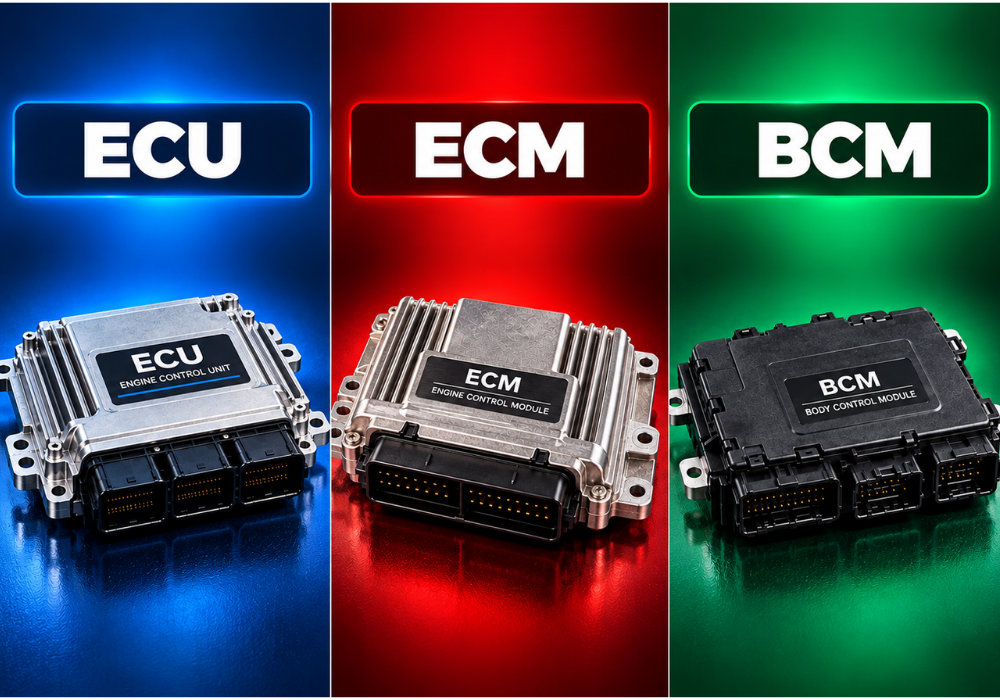
Three terms that often cause confusion are ECU, ECM, and BCM. They are all electronic control units, but they are not necessarily three separate computers.
The most important distinction is that ECU and ECM can refer to the same engine-control computer, depending on the manufacturer and context, while the BCM is a body-focused control module responsible for many electrical, comfort, convenience, and security functions.
Understanding these differences is important for both vehicle owners and automotive technicians because it helps determine which system should be investigated when a fault occurs.
What Is an ECU?
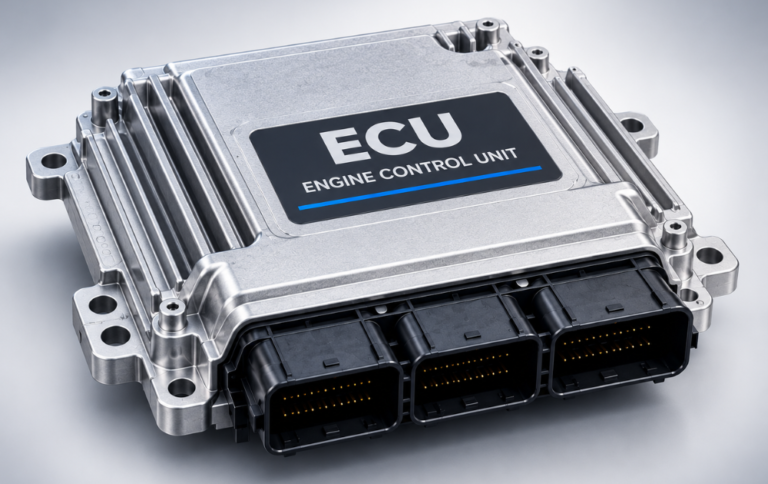
ECU commonly stands for Engine Control Unit when discussing engine management.
The ECU is responsible for monitoring engine conditions and controlling different aspects of engine operation. It receives information from sensors, processes that information using programmed software, and sends commands to actuators.
Depending on the vehicle, an engine-control ECU may manage:
- Fuel injection
- Ignition timing
- Electronic throttle control
- Air-fuel management
- Variable valve timing
- Emissions systems
- Turbocharger control
- Engine cooling strategies
- Torque management
- Engine protection functions
The basic process can be simplified as:
Sensors → ECU → Actuators
For example, sensors may provide information about engine speed, coolant temperature, airflow, intake pressure, throttle position, and oxygen content. The ECU uses this information to determine how the engine should operate.
What Is an ECM?
ECM stands for Engine Control Module.
In many vehicles, the ECM performs essentially the same engine-management role commonly associated with an ECU.
The ECM can receive information from numerous engine sensors and control systems such as:
- Fuel injectors
- Ignition coils
- Electronic throttle systems
- Variable valve timing
- Emissions components
- Turbocharger control
- Cooling systems
The important thing to understand is that ECM and ECU are not universally separate modules.
Some manufacturers use the term ECM, while others use ECU. In some contexts, ECU can also mean Electronic Control Unit, which is a broader term for an electronic module anywhere in the vehicle.
Therefore, the exact meaning depends on the vehicle manufacturer and the terminology used in its service information.
What Is a BCM?
BCM stands for Body Control Module.
Unlike the ECU or ECM, which primarily deals with engine management, the BCM is mainly responsible for body, comfort, convenience, security, and electrical functions.
Depending on the vehicle, the BCM may control or coordinate:
- Exterior lighting
- Interior lighting
- Turn signals
- Hazard lights
- Power door locks
- Power windows
- Windshield wipers
- Keyless entry
- Alarm and security functions
- Horn
- Mirrors
- Power management
- Communication with other control modules
The exact functions vary from one vehicle to another.
The BCM may directly control certain components while communicating with separate modules that control other functions.
ECU vs ECM vs BCM: The Main Difference
The easiest way to understand the three terms is to look at their primary responsibilities.
| Module | Meaning | Main Area | Typical Functions |
|---|---|---|---|
| ECU | Engine Control Unit | Engine management | Fuel, ignition, throttle, emissions |
| ECM | Engine Control Module | Engine management | Fuel, ignition, throttle, engine control |
| BCM | Body Control Module | Body and electrical systems | Lights, locks, windows, wipers, security |
The key point is:
ECU and ECM can describe the same engine-control computer.
BCM is a different module focused mainly on vehicle body and electrical functions.
ECU and ECM: Are They the Same?
This is one of the most common sources of confusion in automotive terminology.
In many vehicles:
ECU = ECM
Both terms can refer to the computer responsible for controlling the engine.
However, the word ECU can also be used more broadly to describe an Electronic Control Unit.
A modern vehicle may contain many electronic control units, including modules responsible for:
- Engine control
- Transmission control
- ABS
- Airbags
- Body functions
- Steering
- Climate control
- Instrument cluster
- Infotainment
- Driver assistance
Because of this, saying that an ECU and ECM are always two different computers would be inaccurate.
The correct interpretation depends on the manufacturer and the context in which the term is being used.
What Does the BCM Control?
The BCM is primarily concerned with systems that the driver interacts with outside of direct engine operation.
For example, when you:
- Lock or unlock the doors
- Turn on the lights
- Activate the windshield wipers
- Open or close certain electrically controlled components
- Use the keyless-entry system
- Activate the horn
- Trigger certain security functions
the BCM may receive the request, process it, and control the appropriate system.
The BCM can therefore act as an important coordinator for many vehicle electrical functions.
How Do ECU, ECM, and BCM Communicate?
Modern vehicles do not operate as a collection of completely independent computers.
Control modules communicate with each other through vehicle communication networks.
One of the most important networks is CAN (Controller Area Network). Some systems may also use LIN (Local Interconnect Network) or other communication technologies.
A simplified example is:
Sensor or Switch → Control Module → Vehicle Network → Another Module → Actuator
For example, the BCM may receive information from a switch and then communicate with another module that needs that information.
The engine-control module can also exchange information with other systems when engine speed, torque, vehicle speed, or other data is required.
This networked design allows different control modules to work together rather than requiring every component to have a direct connection to every other component.
ECU/ECM vs BCM: A Simple Example
Imagine two different situations.
The driver presses the accelerator
The engine-control system receives information from the accelerator pedal and other engine sensors.
The ECU or ECM processes the information and determines the appropriate engine response.
It may then control the throttle, fuel injection, ignition, and other engine systems.
Accelerator → ECU/ECM → Engine control systems
The driver presses the door-lock button
The request may be received by the BCM.
The BCM processes the request and controls or communicates with the appropriate door-lock system.
Lock request → BCM → Door-lock system
These examples show why different control modules exist in modern vehicles.
What Happens When an ECU or ECM Has a Problem?
Because the ECU/ECM manages engine operation, a problem affecting the engine-control system can produce symptoms such as:
- Difficult starting
- Engine performance problems
- Poor acceleration
- Rough running
- Misfire-related symptoms
- Poor fuel economy
- Throttle problems
- Warning lights
- Engine-related communication faults
- Reduced-power or limp-mode operation
However, these symptoms do not automatically mean that the ECU or ECM itself has failed.
A problem with a sensor, wiring, power supply, ground, actuator, or communication network can create similar symptoms.
What Happens When a BCM Has a Problem?
Because the BCM manages many body and electrical functions, BCM-related problems can affect several seemingly unrelated systems at the same time.
Possible symptoms include:
- Power locks not working
- Windows not operating correctly
- Interior lights staying on or not working
- Exterior lighting problems
- Wiper problems
- Turn-signal or hazard-light problems
- Keyless-entry problems
- Security-system problems
- Horn problems
- Battery drain
- Multiple communication faults
- Intermittent electrical problems
A particularly important diagnostic clue is when several body electrical functions begin malfunctioning at the same time.
However, this still does not prove that the BCM is defective.
Does a Fault Code Mean the Module Is Bad?
No.
This is one of the most important concepts in automotive diagnostics.
A Diagnostic Trouble Code (DTC) usually tells you that a control module detected an abnormal condition. It does not necessarily identify the component that actually caused the problem.
For example, a communication code could be caused by:
- Low battery voltage
- Poor grounding
- Damaged wiring
- Corroded connectors
- A network problem
- Another faulty control module
- A configuration problem
- Software issues
- An actual module failure
Replacing a control module simply because a scan tool produced a code can therefore lead to unnecessary repairs.
How Are ECU, ECM, and BCM Problems Diagnosed?
Professional diagnosis normally starts by determining what the vehicle is doing and what information the control module is receiving.
A technician may check:
- Battery voltage
- Charging-system operation
- Fuses
- Module power supplies
- Module grounds
- Wiring and connectors
- Communication networks
- Diagnostic trouble codes
- Live data
- Sensor signals
- Actuator operation
- Module configuration and programming
The diagnostic scanner is an important tool, but it is only part of the process.
A good diagnosis connects the scan-tool information with electrical measurements, wiring diagrams, system operation, and physical testing.
Do ECU, ECM, and BCM Need Programming?
Control modules may require programming or configuration, particularly after replacement.
Depending on the vehicle, this can include:
- Software programming
- Coding
- Configuration
- Initialization
- Calibration
- Security synchronization
- Immobilizer-related procedures
- Vehicle-specific parameter setup
This is why replacing a module is not always a simple plug-and-play operation.
The exact procedure depends on the vehicle manufacturer, model, year, and control-module architecture.
Why Can One Fault Affect Multiple Modules?
Modern vehicles are highly interconnected.
A problem in one area can sometimes affect several systems because modules share information and depend on common power supplies and communication networks.
For example:
Battery / Power Supply → Control Modules → Communication Network → Vehicle Systems
A low-voltage condition can cause multiple modules to behave abnormally.
Likewise, a communication-network problem can prevent several modules from exchanging information correctly.
This is why technicians should not automatically replace multiple modules when several fault codes appear at once.
ECU vs ECM vs BCM: Which One Should You Check?
It depends on the symptoms.
If the problem involves:
Engine performance, fuel, ignition, throttle, or engine emissions
Start with the engine-control system, which may be referred to as the ECU or ECM.
If the problem involves:
Lights, locks, windows, wipers, security, keyless entry, or other body electrical functions
The BCM and related body systems become more relevant.
If multiple systems are affected:
Do not immediately blame one module.
Check:
- Power
- Ground
- Fuses
- Wiring
- Connectors
- Communication networks
- Relevant modules
- System inputs and outputs
The goal is to determine where the expected signal, power, or communication is being lost.