ABS vs ESP: Understanding the Differences Between These Essential Car Safety Systems
In this article
ABS vs ESP: Understanding the Differences Between These Essential Car Safety Systems
Modern vehicles use electronic safety systems to help drivers maintain control and reduce the risk of accidents. Two of the most important technologies are the Anti-lock Braking System (ABS) and the Electronic Stability Program (ESP). Although they share several components and often work together, they have different purposes.
ABS helps prevent the wheels from locking during braking, allowing the driver to maintain better steering control. ESP goes a step further by monitoring the vehicle’s movement and intervening when the car begins to lose directional stability.
Understanding the difference between ABS and ESP helps drivers recognize how these systems protect them, understand dashboard warning lights, and identify potential problems when a fault occurs.
1. What Is the ABS System?
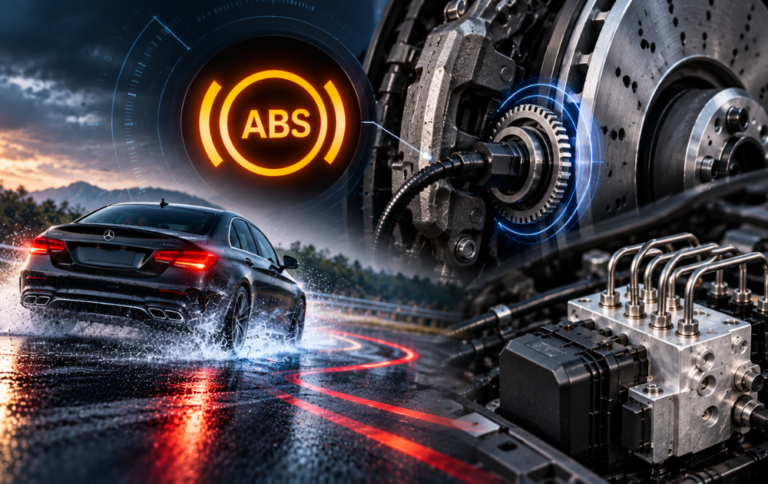
ABS stands for Anti-lock Braking System. It is an electronic safety system designed to prevent the wheels from locking during hard braking.
When a wheel locks, it stops rotating while the vehicle is still moving. This can reduce the driver’s ability to steer, particularly on slippery surfaces.
ABS monitors the rotational speed of individual wheels. If the system detects that a wheel is about to lock, it automatically adjusts brake pressure to help the wheel continue rotating.
This process can occur several times per second, allowing the driver to maintain better steering control while braking.
Example of ABS in Action
Imagine driving at moderate speed when a vehicle suddenly stops in front of you. You press the brake pedal firmly, and one or more wheels risk locking.
ABS detects the situation and rapidly regulates brake pressure to the affected wheels. You may feel a pulsing sensation through the brake pedal, which is normal during ABS activation.
The main purpose of ABS is to help prevent wheel lock during braking and preserve steering control.
However, ABS does not guarantee a shorter stopping distance in every situation. On loose gravel, deep snow, or other surfaces with particular traction characteristics, stopping distances can vary.
2. What Is the ESP System?
ESP stands for Electronic Stability Program. It is an active safety system designed to help drivers maintain directional control when the vehicle begins to skid or deviate from its intended path.
Unlike ABS, which primarily responds to the risk of wheel lock during braking, ESP monitors how the vehicle is moving in relation to the driver’s steering input.
The system uses information from several sensors to determine whether the vehicle is following the intended direction. If it detects instability, it can apply the brakes to selected wheels and, when supported, reduce engine torque.
Example of ESP in Action
Imagine driving around a corner when the road becomes slippery. You turn the steering wheel, but the vehicle begins sliding toward the outside of the turn.
ESP detects that the vehicle’s actual movement differs from the intended direction. It can then apply corrective braking to selected wheels to help restore stability.
This intervention happens automatically and can help reduce the severity of a skid when sufficient tire grip remains available.
The main purpose of ESP is to help maintain vehicle stability and reduce the risk of losing directional control.
ESP is also known as Electronic Stability Control (ESC) or by other manufacturer-specific names, such as Dynamic Stability Control (DSC).
3. The Main Differences Between ABS and ESP
Although ABS and ESP are closely related, their main functions are different.
| Feature | ABS | ESP |
|---|---|---|
| Full name | Anti-lock Braking System | Electronic Stability Program |
| Main purpose | Helps prevent wheel lock during braking | Helps maintain directional stability |
| Main operating condition | When a wheel is at risk of locking during braking | When the vehicle begins to deviate from its intended path |
| Main control method | Regulates brake pressure to prevent wheel lock | Applies braking to selected wheels and may reduce engine torque |
| Steering control | Helps preserve steering control during braking | Helps correct certain skids and maintain the intended trajectory |
| Main sensor information | Primarily wheel speed data | Wheel speeds, steering angle, yaw rate, and other vehicle data |
| Engine torque intervention | Not a primary ABS function | May request torque reduction when necessary |
| Relationship | Can operate as a standalone function or within an integrated system | Commonly uses ABS-related sensors and hydraulic components |
The most important distinction is that ABS manages wheel lock during braking, while ESP manages vehicle stability when the car begins to lose directional control.
4. How Do ABS and ESP Work Together?
ABS and ESP are often integrated into the same electronic braking and vehicle dynamics system.
They can share wheel speed sensors, an electronic control unit or closely coordinated controllers, and an ABS hydraulic control unit.
However, sharing components does not mean that they perform the same task.
ABS regulates brake pressure when a wheel is at risk of locking. ESP uses sensor information to assess the vehicle’s overall movement and can command selective braking to help correct instability.
For example, if ESP detects that a vehicle is beginning to oversteer, it may request braking at a particular wheel. The hydraulic system then controls the brake pressure as needed.
The same hydraulic hardware can therefore support different functions depending on the situation.
Why Is This Integration Important?
Because the systems share components, a fault in one part can affect several safety functions.
A faulty wheel speed sensor, damaged wiring, low system voltage, or an ABS control unit problem may trigger both ABS and ESP warning lights.
This is why a technician should investigate the stored fault codes and relevant sensor data instead of assuming that each warning light represents a separate failure.
5. ABS vs. ESP: What Happens in Different Driving Situations?
The easiest way to understand the difference is to examine how each system responds to everyday driving situations.
Situation 1: Emergency Braking in a Straight Line
A driver suddenly encounters an obstacle and presses the brake pedal firmly.
ABS: Helps prevent the wheels from locking and allows the driver to maintain better steering control during braking.
ESP: May remain ready to intervene if the braking maneuver also causes the vehicle to become unstable, but preventing wheel lock is primarily the ABS function.
Situation 2: Cornering on a Slippery Road
A vehicle enters a bend and begins sliding toward the outside of the curve.
ABS: Does not primarily address this situation unless wheel lock becomes a concern during braking.
ESP: Detects the difference between the intended direction and the vehicle’s actual movement. It can apply corrective braking to help restore stability.
Situation 3: Accelerating on a Slippery Surface
The driver accelerates, but one or more driven wheels begin spinning excessively.
ABS: Is not primarily designed to control wheel spin during acceleration.
ESP and traction control: Traction control can reduce excessive wheel spin by regulating braking or engine torque. It is often integrated with ESP, although traction control and stability control remain distinct functions.
Situation 4: Sudden Steering to Avoid an Obstacle
The driver quickly changes direction to avoid a vehicle or another obstacle.
ABS: May help if the driver brakes hard enough for wheel lock to become a concern.
ESP: Monitors the vehicle’s response to the steering input and can intervene if the vehicle begins to lose directional stability.
These examples show that ABS and ESP address different problems, even though they can operate simultaneously during a difficult maneuver.
6. Main Components: What Do ABS and ESP Share?
Because ABS and ESP are closely integrated in many vehicles, several components may support both systems.
Wheel Speed Sensors
These sensors measure the rotational speed of individual wheels. ABS uses the readings to identify the risk of wheel lock, while ESP also uses them to assess wheel behavior and vehicle movement.
A faulty sensor or damaged encoder can affect both functions.
ABS Hydraulic Control Unit
The hydraulic control unit contains valves and other components that regulate brake pressure.
ABS uses it to help prevent wheel lock. ESP uses the same or related hydraulic hardware to apply braking force selectively when correcting instability.
Electronic Control Unit
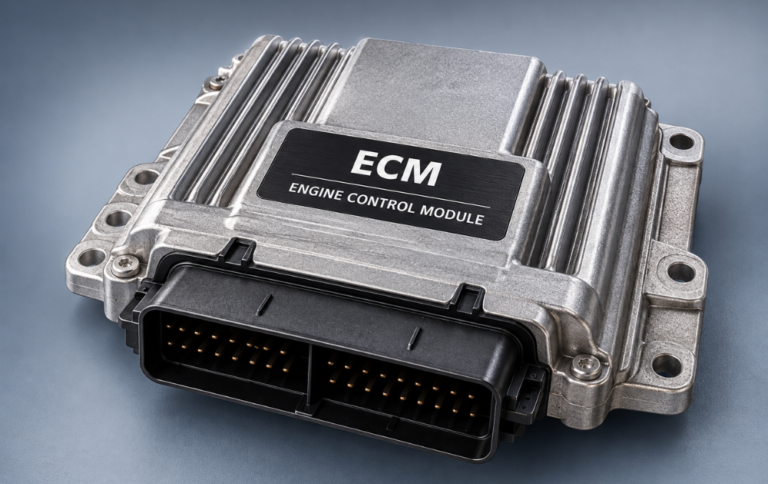
The electronic control system processes sensor information and coordinates the relevant safety functions.
Depending on the vehicle, ABS and ESP functions may be managed by a combined controller or by coordinated electronic modules.
Additional ESP Sensors
ESP requires additional information about the driver’s intended direction and the vehicle’s actual movement.
These measurements commonly include:
- Steering angle sensor: Measures steering wheel angle.
- Yaw rate sensor: Measures the vehicle’s rotation around its vertical axis.
- Lateral acceleration sensor: Measures sideways acceleration during vehicle movement.
These sensors help ESP determine whether the vehicle is turning as expected or beginning to skid.
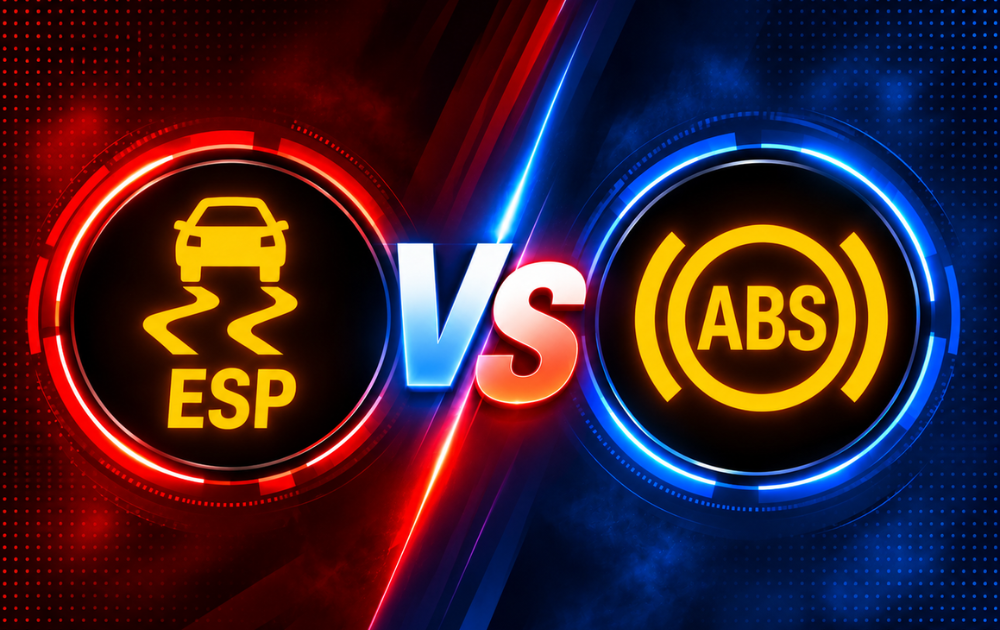
7. ABS and ESP Warning Lights: What Do They Mean?
Dashboard warning lights help drivers understand when a safety system is active, switched off, or reporting a fault.
ABS Warning Light
If the ABS warning light remains illuminated after the normal startup checks, the system may have detected a fault.
Possible causes include a faulty wheel speed sensor, damaged wiring, electrical supply problems, or an ABS control unit fault.
Conventional braking may remain available, but ABS may not function correctly.
ESP Warning Light
A flashing ESP light commonly indicates that the system is actively intervening because it has detected wheel slip or instability.
If the light stays on continuously, the system may have been switched off or may have detected a fault.
The precise meaning depends on the vehicle and its warning indicators.
ABS and ESP Lights Illuminated Together
When both lights remain on, a shared component or electrical problem may be responsible.
Possible causes include:
- A faulty wheel speed sensor.
- Damaged sensor wiring or connectors.
- Low battery voltage.
- An ABS hydraulic control unit or electronic control fault.
- A communication or calibration problem.
The warning lights alone cannot confirm the cause. A diagnostic scan and appropriate testing are needed.
Safety note: If braking performance changes, the brake pedal feels abnormal, or a red brake warning light appears, stop somewhere safe and seek professional assistance.
8. How Are ABS and ESP Faults Diagnosed?
Although the systems share components, accurate diagnosis requires understanding which function has failed and why.
A professional diagnostic process generally includes the following steps.
Step 1: Read the fault codes. Use a compatible diagnostic tool to scan the ABS/ESP control unit and record relevant fault information.
Step 2: Check live sensor data. Compare wheel speed readings and, when relevant, steering angle, yaw rate, lateral acceleration, and system voltage.
Step 3: Inspect the relevant components. Examine sensor wiring, connectors, wheel encoders, electrical grounds, and the hydraulic unit as indicated by the test results.
Step 4: Perform electrical tests. If necessary, verify power supply, ground, continuity, and signal circuits using the correct wiring information and testing procedures.
Step 5: Repair and verify. Repair the confirmed fault, perform any required calibration, clear codes when appropriate, and confirm that the problem does not return.
A fault code does not automatically mean the named component must be replaced. For example, a wheel speed sensor code may be caused by a damaged wire, connector, or encoder rather than the sensor itself.
A structured diagnosis helps avoid unnecessary parts replacement and ensures that related safety functions are checked.
9. Can You Drive If ABS or ESP Is Not Working?
The answer depends on which system is affected, the underlying fault, and the vehicle’s behavior.
If ABS is unavailable, conventional braking may still work, but the wheels may be more likely to lock during hard braking. This can reduce steering control.
If ESP is unavailable, the vehicle may have less electronic assistance when it begins to skid or lose directional stability.
If both systems are affected, the driver may lose two important forms of electronic safety assistance.
If a warning light appears:
- Reduce your speed and leave more distance between vehicles.
- Avoid sudden braking, acceleration, and steering maneuvers.
- Check the owner’s manual for the meaning of the warning.
- Arrange a diagnostic inspection promptly.
If the red brake warning light appears, braking performance changes, or the pedal feels abnormal, stop safely and seek professional assistance.
Do not assume that every braking function is working normally simply because the vehicle can still be driven.
10. Which System Is More Important: ABS or ESP?
ABS and ESP serve different safety purposes, so they should not be treated as interchangeable systems.
ABS helps manage wheel lock during braking. ESP helps maintain directional stability when the vehicle begins to deviate from the intended path.
A vehicle equipped with both systems benefits from complementary forms of electronic assistance. Neither system can overcome every situation, and both depend on factors such as tire condition, road grip, vehicle speed, and correct system operation.
The key point is not to choose one system over the other, but to understand how they work together to support safer driving.
Frequently Asked Questions
Is ESP the Same as ABS?
No. ABS helps prevent wheel lock during braking, while ESP helps maintain directional stability when the vehicle begins to skid. ESP commonly uses components shared with ABS.
Can ABS Work Without ESP?
Yes. ABS can operate as a separate function. However, on vehicles designed with integrated braking and stability control, certain faults may affect multiple functions.
Can ESP Work Without ABS?
ESP generally relies on ABS-related hydraulic components to apply braking pressure selectively. If a critical ABS component fails, ESP may also become unavailable.
Why Do the ABS and ESP Warning Lights Appear Together?
Both systems share components and sensor information. A faulty wheel speed sensor, electrical problem, or ABS control unit fault can affect both systems.
Does ESP Replace ABS?
No. ESP does not replace ABS. The systems perform different functions and commonly work together.
Does ABS Always Reduce Stopping Distance?
No. ABS is designed primarily to help prevent wheel lock and preserve steering control during braking. Stopping distance depends on the surface, tire grip, speed, and other conditions.
Does ESP Prevent Every Skid?
No. ESP can help correct certain stability problems, but it cannot overcome the physical limits of tire grip or guarantee that the vehicle will avoid an accident.