

ABS System Explained: How Anti-Lock Brakes Work, Common Faults, and Diagnostics
In this article
ABS System Explained: How Anti-Lock Brakes Work, Common Faults, and Diagnostics
Imagine driving on a wet road when the vehicle in front of you suddenly brakes. You press the brake pedal firmly, but the tires begin to lose grip. In this situation, your ability to control the car can make the difference between avoiding an accident and losing control.
This is where the ABS (Anti-lock Braking System) plays an important role.
ABS is one of the most important safety systems in modern vehicles. It helps prevent the wheels from locking during hard braking, allowing the driver to maintain better steering control while slowing down. Although many drivers use cars equipped with ABS every day, they do not always understand how the system works, which components make it function, or what to do when the ABS warning light appears.
Understanding ABS is useful for every driver and especially valuable for automotive students, mechanics, and technicians who want to improve their diagnostic skills.
In this guide, you will learn how the ABS system works, discover the role of its main components, understand the difference between ABS, EBD, and ESP/ESC, identify common faults, and learn how technicians diagnose ABS problems.
1. What Is an ABS System?
ABS stands for Anti-lock Braking System. It is an electronic safety system designed to prevent a vehicle’s wheels from locking during braking.
Wheel lock occurs when a tire stops rotating while the vehicle is still moving. Instead of rolling along the road, the tire slides across the surface. This can significantly reduce the driver’s ability to steer, particularly when the front wheels lose their grip.
ABS helps prevent this situation by monitoring wheel speed and automatically adjusting brake pressure when a wheel approaches lock-up.
Unlike a conventional braking system, which relies on the driver and hydraulic components to apply braking force, ABS can regulate brake pressure rapidly and individually at the wheels, depending on the system’s design.
Why Is ABS Important?
The main purpose of ABS is not simply to stop a vehicle as quickly as possible. Its most important benefit is helping the driver maintain directional control during hard braking.
For example, imagine that an obstacle suddenly appears in front of your car. If the wheels lock, steering may become much less effective because the tires are sliding instead of rolling normally.
With ABS, the system works to prevent prolonged wheel lock, helping the tires retain the grip needed for steering while braking.
The main benefits of ABS include:
- Helping prevent wheel lock during emergency braking.
- Improving steering control during hard braking.
- Helping maintain vehicle stability during certain braking situations.
- Reducing the risk of uncontrolled skidding caused by locked wheels.
- Supporting other safety systems, such as electronic brake-force distribution and electronic stability control.
However, ABS cannot eliminate the laws of physics. It does not guarantee a shorter stopping distance in every situation, and it cannot compensate for worn tires, excessive speed, or insufficient road grip.
2. How Does the ABS System Work?
To understand ABS, it helps to know what happens when you press the brake pedal.
In a conventional hydraulic braking system, pressing the pedal creates hydraulic pressure in the brake lines. This pressure operates the brake calipers or wheel cylinders, allowing the brake pads or shoes to slow the wheels.
Under normal conditions, ABS allows the braking system to operate normally.
The difference appears when the system detects that one or more wheels are approaching lock-up.
The ABS Operating Process
Step 1: Wheel speed monitoring
Wheel speed sensors continuously measure the rotational speed of the wheels and send signals to the ABS control unit.
Step 2: Detection of potential wheel lock
When the driver brakes hard, one or more wheels may begin to slow down much faster than expected. The ABS control unit analyses the sensor signals to determine whether a wheel is approaching lock-up.
Step 3: Brake pressure adjustment
If the control unit detects a potential lock-up, it commands the hydraulic control unit to adjust the pressure applied to the affected wheel.
Step 4: Pressure release and recovery
The system can reduce brake pressure to allow the wheel to regain rotation and traction. It then increases or holds the pressure as necessary.
Step 5: Continuous regulation
The system repeats this process rapidly while intervention is needed, helping the wheels remain within a controllable range of slip.
The driver may feel the brake pedal pulsating or hear a buzzing or mechanical sound during ABS activation. These sensations can be normal when the system is actively regulating brake pressure.
The Three Main Phases of ABS Pressure Control
| Phase | What Happens | Purpose |
|---|---|---|
| Pressure increase | Brake pressure is allowed to rise | Apply braking force |
| Pressure hold | Pressure is temporarily maintained | Prevent excessive wheel deceleration |
| Pressure decrease | Pressure is reduced at the affected wheel | Help the wheel regain rotation |
These phases are controlled electronically and hydraulically. Their timing depends on wheel behaviour, road conditions, and the specific ABS design.
Important for drivers: During an emergency stop in a vehicle equipped with functioning ABS, press the brake pedal firmly and continuously, and steer as needed to avoid the obstacle. Do not repeatedly pump the brake pedal, because the ABS is designed to regulate braking pressure automatically.
Always maintain a safe distance and adjust your speed to road and weather conditions.
3. What Are the Main Components of an ABS System?
The ABS system combines electronic sensors, a control unit, hydraulic components, and electrical connections. Each component has a specific role, and a fault in any of them can affect the system’s operation.
3.1. Wheel Speed Sensors
Wheel speed sensors measure how fast each wheel rotates. Their signals allow the ABS control unit to detect changes in wheel speed and identify potential wheel lock.
Depending on the vehicle, sensors may be installed near the wheel hubs, bearings, or other rotating components.
Modern systems may use active magnetic sensors, while some older designs use passive sensors.
A wheel speed sensor can develop problems because of physical damage, contamination, wiring faults, corrosion, or an issue with the magnetic encoder or toothed reluctor ring it reads.
Common symptoms of a wheel speed sensor problem:
- The ABS warning light remains illuminated.
- The traction control or stability control warning light appears.
- ABS activates unexpectedly at low speed.
- The diagnostic system records an implausible wheel speed signal.
A warning light does not automatically mean the sensor itself is defective. The wiring, connector, sensor mounting, wheel bearing, or encoder ring may also be responsible.
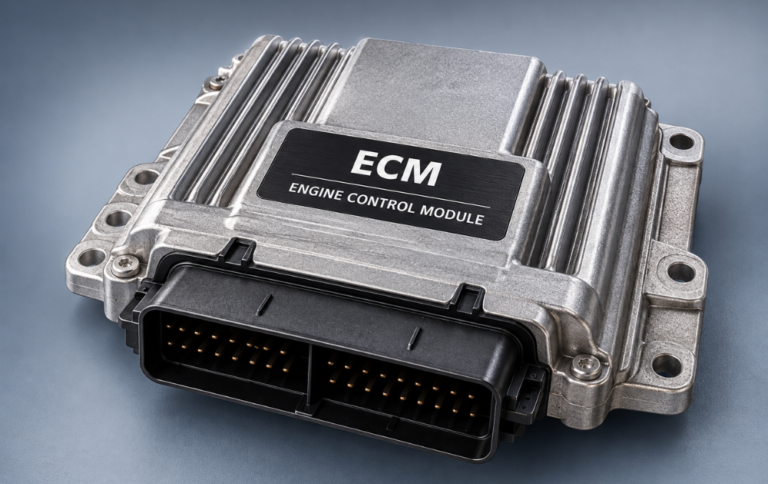
3.2. ABS Electronic Control Unit
The ABS electronic control unit, often called the ABS ECU or ABS module, is the system’s control centre.
It receives information from the wheel speed sensors, evaluates wheel behaviour, and determines when brake pressure needs to be adjusted.
Depending on the vehicle, the module may also manage traction control and communicate with the electronic stability control system.
If the control unit detects a fault, it may store a diagnostic trouble code and illuminate the ABS warning light.
Possible problems include internal electronic failure, damaged connectors, water intrusion, poor electrical connections, or interrupted power and ground supplies.
Before replacing an ABS control unit, a technician should verify its power supply, ground connections, wiring, sensor signals, and relevant fault codes.
3.3. Hydraulic Control Unit
The hydraulic control unit is the part that physically regulates brake pressure during ABS activation.
It is commonly called the hydraulic modulator or hydraulic control unit (HCU). Depending on the design, it may be integrated with the ABS pump and electronic control module.
The unit contains electrically controlled valves that allow the system to increase, hold, or reduce hydraulic pressure at selected wheels.
During ordinary braking, the hydraulic system operates in its normal configuration. When ABS intervention is required, the valves change state according to commands from the control unit.
Problems within the hydraulic unit can affect pressure regulation and may require specialised testing.
3.4. ABS Hydraulic Pump
The ABS pump helps restore hydraulic pressure during system intervention.
When brake pressure is reduced at a wheel, the pump and associated hydraulic passages help manage the fluid so that braking pressure can be reapplied as required.
A pump or pump motor fault may disable ABS intervention and trigger a warning light.
Possible symptoms include a stored pump-related fault code, an abnormal pump sound, or failure of the ABS self-test. However, the exact symptoms vary by vehicle.
3.5. Solenoid Valves
Solenoid valves are electrically controlled valves inside the hydraulic modulator.
They regulate brake fluid pressure by controlling the flow of hydraulic fluid through the relevant circuits.
Depending on the design, the valves allow the system to increase, hold, or decrease pressure at a wheel.
A valve fault, electrical problem, or internal hydraulic issue can prevent the system from regulating pressure correctly.
3.6. Wiring, Connectors, and Fuses
The ABS depends on a reliable electrical supply and communication between its components.
Wiring and connectors carry sensor signals and provide power to the control unit, pump, and valves. Fuses and relays, where fitted, help protect and control the electrical circuits.
A damaged wire, corroded connector, poor ground, or blown fuse can disable part or all of the ABS system.
These faults should be checked before expensive components are replaced.
ABS Components at a Glance
| Component | Main Function | Possible Fault |
|---|---|---|
| Wheel speed sensors | Measure wheel rotation | Missing or incorrect speed signal |
| ABS control unit | Analyses signals and controls intervention | Communication or internal electronic fault |
| Hydraulic control unit | Regulates brake pressure | Pressure-control malfunction |
| ABS pump | Helps restore hydraulic pressure | Pump motor or electrical fault |
| Solenoid valves | Control hydraulic fluid flow | Valve circuit or hydraulic malfunction |
| Wiring and connectors | Carry power and sensor signals | Open circuit, short circuit, corrosion, or poor connection |
4. What Are the Different Types of ABS Systems?
ABS systems can be classified according to the number of sensors and the way the wheels are controlled.
The exact configuration depends on the vehicle’s age, design, and intended application.
Four-Channel, Four-Sensor ABS
This is a common configuration in modern passenger cars.
Each wheel has its own wheel speed sensor, and the system can regulate braking pressure individually at all four wheels.
This arrangement gives the control unit detailed information about each wheel’s behaviour and allows precise pressure regulation.
Typical application: Modern passenger cars and many light commercial vehicles.
Three-Channel, Three-Sensor ABS
In a common three-channel arrangement, each front wheel has an individual sensor and control channel, while the rear wheels share a control channel.
The system can regulate the front wheels independently but has less independent control over the rear wheels than a four-channel arrangement.
Typical application: Certain older vehicle designs.
Two-Channel or One-Channel ABS
Some older or specialised vehicle designs use fewer control channels.
A two-channel system may regulate the wheels in pairs, while a one-channel design may control a group of wheels through a shared circuit.
These configurations provide less individual control than a four-channel system.
The number of sensors alone does not tell the complete story. The hydraulic circuit arrangement and the way the control unit regulates each wheel are also important.
5. What Is the Difference Between ABS, EBD, and ESP/ESC?
ABS is often confused with EBD and ESP/ESC because these systems can share sensors, control units, and hydraulic components.
Although they work together, their primary purposes are different.
ABS: Anti-lock Braking System
ABS helps prevent wheel lock during braking. Its main purpose is to help the driver maintain steering control when braking hard.
EBD: Electronic Brake-force Distribution
EBD adjusts how braking force is distributed between the wheels according to vehicle conditions.
The system can take into account factors such as wheel behaviour and vehicle load to help use available tire grip effectively.
EBD often works alongside ABS and may use the same sensors and hydraulic hardware.
ESP/ESC: Electronic Stability Control
ESP and ESC are names commonly used for electronic stability control systems.
These systems help the driver maintain directional stability when the vehicle begins to deviate from the intended path.
Depending on the vehicle, ESC may use wheel speed sensors, steering angle information, yaw-rate data, lateral acceleration measurements, and selective braking to help correct the vehicle’s movement. Some systems can also request engine torque reduction.
Comparison Table
| System | Main Purpose | Typical Operation |
|---|---|---|
| ABS | Prevent wheel lock during braking | Adjusts brake pressure at wheels approaching lock-up |
| EBD | Distribute braking force appropriately | Adjusts brake-force distribution between wheels |
| ESP/ESC | Help maintain directional stability | May brake individual wheels and reduce engine torque |
These systems complement one another, but they are not interchangeable. A vehicle can have a fault affecting one function while other functions continue to operate, depending on the fault and system design.
6. What Happens When the ABS System Fails?
An ABS fault does not always mean that the vehicle’s conventional brakes have completely stopped working.
In many vehicles, if ABS develops a fault, conventional hydraulic braking remains available, but the anti-lock function may be disabled. Other related functions, including traction control or stability control, may also be affected.
However, you should never assume that the brakes are safe simply because the pedal still works.
Common Signs of an ABS Problem
1. ABS warning light stays on
The ABS warning light may illuminate during the ignition self-check and then switch off if the system passes its checks. If it remains on or illuminates while driving, the system may have detected a fault.
2. Traction control or stability control warning lights appear
Because these systems often share wheel speed information, an ABS-related fault can affect traction control or stability control.
3. ABS activates unexpectedly at low speeds
If the ABS activates just before the vehicle stops under light braking, an incorrect wheel speed signal may be responsible. Possible causes include a damaged encoder ring, a sensor issue, excessive sensor gap, or a wiring problem.
4. ABS does not activate during a situation that would normally require it
A driver cannot reliably confirm ABS operation simply by testing the brakes on a public road. A warning light, diagnostic code, or professional test may reveal a fault.
5. The speedometer or related systems behave abnormally
On some vehicles, wheel speed information is shared with other electronic systems. Depending on the design and fault, a sensor or communication problem may affect additional functions.
A technician should interpret these symptoms alongside diagnostic data rather than replacing parts based on symptoms alone.
7. What Causes ABS Failure?
Several faults can trigger the ABS warning light. Some are relatively simple to repair, while others require specialised diagnosis.
Faulty Wheel Speed Sensor
A damaged or contaminated sensor may send an incorrect signal or no signal at all.
Before replacing it, check the sensor, connector, wiring, mounting position, and the rotating encoder or reluctor ring.
Damaged Encoder Ring or Wheel Bearing
The sensor needs a reliable target to measure wheel rotation.
Depending on the design, this may be a toothed reluctor ring or a magnetic encoder integrated into the wheel bearing or hub.
Cracks, corrosion, physical damage, contamination, or a defective magnetic encoder can produce an incorrect signal.
Replacing the sensor alone will not solve a fault caused by a damaged encoder ring.
Electrical Wiring Problems
A broken wire, short circuit, corroded connector, or poor ground can interrupt communication between a sensor and the ABS control unit.
Intermittent wiring faults may be particularly difficult to diagnose because the warning light may appear only under certain conditions.
Blown Fuse or Power Supply Fault
The ABS control unit and pump require a reliable electrical supply.
A blown fuse, faulty relay where fitted, poor ground, or damaged power connection can prevent the system from operating.
A fuse should never be replaced repeatedly without investigating why it failed.
ABS Pump or Hydraulic Unit Fault
A faulty pump motor, defective valve circuit, or internal hydraulic problem may interfere with pressure regulation.
These faults can require more advanced testing and, in some cases, specialised equipment.
ABS Control Unit Failure
The electronic control unit may develop an internal fault or suffer from damaged connections, moisture, or electrical problems.
However, a control-unit fault code does not always prove that the module itself is defective. The underlying power, ground, wiring, and connected components must be checked first.
Low Brake Fluid or a Problem With the Conventional Brakes
Low brake fluid is not proof of an ABS fault, but it may indicate a leak or another braking-system problem that requires immediate attention.
Brake fluid can also fall as brake pads wear, depending on the system, so the cause must be identified rather than simply topping up the reservoir.
If the fluid level is below the minimum mark, inspect the system and follow the vehicle manufacturer’s instructions. Do not ignore a low-fluid warning.
8. How Do Technicians Diagnose an ABS Problem?
Correct ABS diagnosis begins with gathering evidence, not immediately replacing the suspected component.
A professional diagnostic process helps identify the actual fault, avoid unnecessary parts replacement, and confirm that the system operates correctly after repair.
Step 1: Check the Warning Lights and Symptoms
The technician first identifies which warning lights are illuminated and asks when the problem occurs.
For example, does the ABS light remain on from startup? Does it appear only after the vehicle starts moving? Does ABS activate unexpectedly at low speed?
These details help narrow the possible causes.
Step 2: Perform a Visual Inspection
The technician checks accessible components for damage, contamination, corrosion, loose connectors, damaged wiring, and signs of leakage.
The brake fluid level and condition should also be checked according to the manufacturer’s procedure.
Step 3: Scan the ABS Control Unit
A compatible diagnostic scan tool is used to communicate with the ABS module and retrieve diagnostic trouble codes.
A basic engine-code reader may not support ABS diagnostics, so the tool must be capable of accessing the relevant system on that vehicle.
The codes help identify which circuit or function the control unit has detected as abnormal.
Important: A diagnostic trouble code identifies a fault condition, not necessarily the exact component that must be replaced.
Step 4: Analyse Live Wheel Speed Data
One of the most useful ABS diagnostic methods is observing wheel speed data while the wheels rotate under appropriate test conditions.
The technician compares the readings to identify missing signals, sudden dropouts, implausible values, or differences that cannot be explained by normal driving conditions.
This can help distinguish a sensor problem from other faults.
Step 5: Test the Electrical Circuit
Depending on the fault, the technician may check wiring continuity, connector condition, power supply, ground, sensor signals, and relevant electrical specifications.
The testing method must match the sensor type. Some active sensors can be damaged by incorrect resistance testing or unsuitable test procedures.
Step 6: Inspect the Encoder Ring and Mechanical Components
If the signal is incorrect, the technician may inspect the encoder ring, wheel bearing, sensor mounting, and air gap where applicable.
This step is important because mechanical damage can produce symptoms similar to an electrical sensor failure.
Step 7: Repair and Verify the System
After the cause is identified, the faulty component or connection is repaired according to the manufacturer’s procedure.
The technician then clears codes where appropriate, repeats the relevant checks, and verifies that the warning lights and system data behave correctly.
Some repairs require a scan-tool procedure, hydraulic bleeding with diagnostic equipment, or a calibration process.
Professional advice: ABS diagnosis should be performed with suitable equipment and service information. Because ABS is a safety-critical system, uncertain repairs should be left to a qualified technician.
9. Can You Drive With the ABS Warning Light On?
This is an important question because many drivers continue using their vehicles after the ABS warning light appears.
If only the amber ABS warning light is illuminated, conventional braking may remain available on many vehicles, but anti-lock protection may be lost. The vehicle may also have reduced or disabled traction control and stability control.
The safest action is to consult the owner’s manual and arrange prompt diagnosis. Avoid high speeds, maintain a greater following distance, and drive cautiously only if the conventional brakes feel normal and the vehicle can be operated safely.
Stop driving as soon as it is safe to do so if:
- The red brake warning light remains illuminated, especially together with the ABS light.
- The brake pedal feels unusually soft, sinks toward the floor, or becomes abnormally hard.
- Braking performance is reduced.
- You notice a brake fluid leak.
- The vehicle pulls strongly to one side during braking or shows other serious braking abnormalities.
In these situations, do not assume that the problem is limited to ABS. Arrange professional assistance or recovery as appropriate.
Never deliberately perform emergency braking tests on public roads to check whether ABS is working.
10. Does ABS Always Reduce Stopping Distance?
ABS can help maintain steering control and can reduce stopping distance on many paved surfaces, but its effect depends on the road, tires, vehicle, and braking conditions.
On wet or dry paved roads, ABS can help the tires use available grip while avoiding prolonged wheel lock.
On loose gravel, deep snow, or some other loose surfaces, ABS may produce a longer stopping distance than a locked wheel in certain conditions. Even in those situations, ABS is designed primarily to preserve control and reduce uncontrolled wheel lock.
This is why drivers should not assume that ABS guarantees the shortest possible stop in every environment.
Stopping distance also depends on:
- Vehicle speed.
- Tire condition and tread depth.
- Road surface and weather.
- Brake condition.
- Vehicle load.
- Driver reaction time.
- Following distance.
For example, tires with poor tread depth may struggle to channel water away from the contact patch. Even with ABS, the available grip may be insufficient to stop quickly.
ABS is a valuable safety system, but it cannot replace good tires, properly maintained brakes, sensible driving, and an appropriate speed.
11. How Can You Maintain the ABS System?
ABS usually does not require a separate routine service interval for every electronic component. However, maintaining the braking system and inspecting relevant components can help prevent faults and identify problems early.
Maintain the Conventional Braking System
Follow the manufacturer’s service schedule for brake fluid replacement, brake pad and disc inspection, and other braking-system maintenance.
Use only the specified brake fluid and approved procedures.
Inspect Wheel Sensors and Wiring
During suitable brake or wheel-bearing service, inspect accessible sensor wiring, connectors, and mounting points for damage or contamination.
Avoid pulling, twisting, or damaging sensor wires during repairs.
Use Suitable Replacement Parts
When replacing an ABS sensor, wheel bearing, encoder ring, or other related component, verify compatibility with the vehicle.
Incorrect parts or poor installation can cause signal problems even when the new component appears to fit.
Respond to Warning Lights Promptly
Do not ignore an ABS warning light just because the vehicle still seems to brake normally.
The system may be unavailable when you need it most, and the underlying fault may affect other safety functions.
Avoid Unnecessary Electrical Modifications
Poorly installed accessories, incorrect wiring repairs, or unsuitable electrical modifications can interfere with vehicle control systems.
Follow approved repair procedures and wiring diagrams when working on ABS circuits.
12. Modern ABS Technology and Its Relationship With Other Safety Systems
ABS has evolved beyond a system that simply prevents wheel lock.
Modern vehicles may integrate ABS with traction control, electronic stability control, electronic brake-force distribution, and advanced driver-assistance features.
These systems can share wheel speed sensors, hydraulic components, and vehicle network communication.
Integrated Electronic Control
In many modern vehicles, a shared electronic platform manages several braking and stability functions.
This integration allows the vehicle to coordinate wheel braking and, where supported, engine torque control to improve stability and traction.
Improved Sensor Technology
Modern wheel speed sensors may use advanced magnetic sensing technology and provide accurate signals across a wide range of operating conditions.
These signals support not only ABS but also other vehicle systems that depend on wheel speed information.
Electronic Stability Control
ESC builds on the capabilities of ABS by helping the vehicle maintain its intended direction during certain skidding situations.
It can selectively apply braking force at individual wheels and may request engine torque reduction when the system detects a loss of directional stability.
Advanced Braking and Driver-Assistance Features
Depending on the vehicle, ABS hardware and related electronic controls may work alongside automatic emergency braking and other driver-assistance functions.
The exact design varies considerably. Not every vehicle uses the same architecture, and not every feature relies on ABS in the same way.
These developments demonstrate how braking technology has become an integrated part of modern vehicle safety rather than an isolated system.
13. Frequently Asked Questions About ABS
What does ABS stand for in a car?
ABS stands for Anti-lock Braking System. It helps prevent the wheels from locking during hard braking so the driver can maintain better steering control.
What does it mean when the ABS light comes on?
It means the system has detected a fault or has identified a condition that requires attention. A diagnostic scan and inspection are needed to determine the cause.
Can ABS work if one wheel speed sensor is faulty?
If a wheel speed sensor or its circuit fails, the control unit may disable ABS or related functions because it cannot reliably monitor wheel behaviour. The exact response depends on the vehicle.
Does ABS work automatically?
Yes. ABS monitors wheel speed and intervenes automatically when necessary. The driver does not need to activate it manually.
Should I pump the brake pedal when ABS activates?
No. In an emergency stop with functioning ABS, press the pedal firmly and continuously while steering as needed. The system automatically regulates brake pressure.
Why does the brake pedal vibrate during ABS activation?
Rapid hydraulic pressure adjustments can cause the pedal to pulse or vibrate. A buzzing or mechanical sound may also occur. These sensations can be normal during active ABS operation.
Can a faulty ABS sensor affect the speedometer?
On some vehicles, wheel speed signals are shared with the speedometer and other electronic systems. A sensor fault may therefore affect additional functions, but the result depends on the vehicle’s design.
Is ABS the same as ESP?
No. ABS helps prevent wheel lock during braking. ESP/ESC helps maintain directional stability and may use selective braking and engine torque reduction.
Can I replace an ABS sensor myself?
Some sensors are accessible, but others require specialised tools or procedures. The correct diagnosis, compatible replacement part, and proper installation are essential. If you are uncertain, use a qualified technician.
Does ABS guarantee that my car will stop quickly?
No. ABS helps control wheel lock, but it cannot overcome limited tire grip, excessive speed, poor road conditions, or worn brakes. Safe driving and vehicle maintenance remain essential.





One Comment
Comments are closed.