
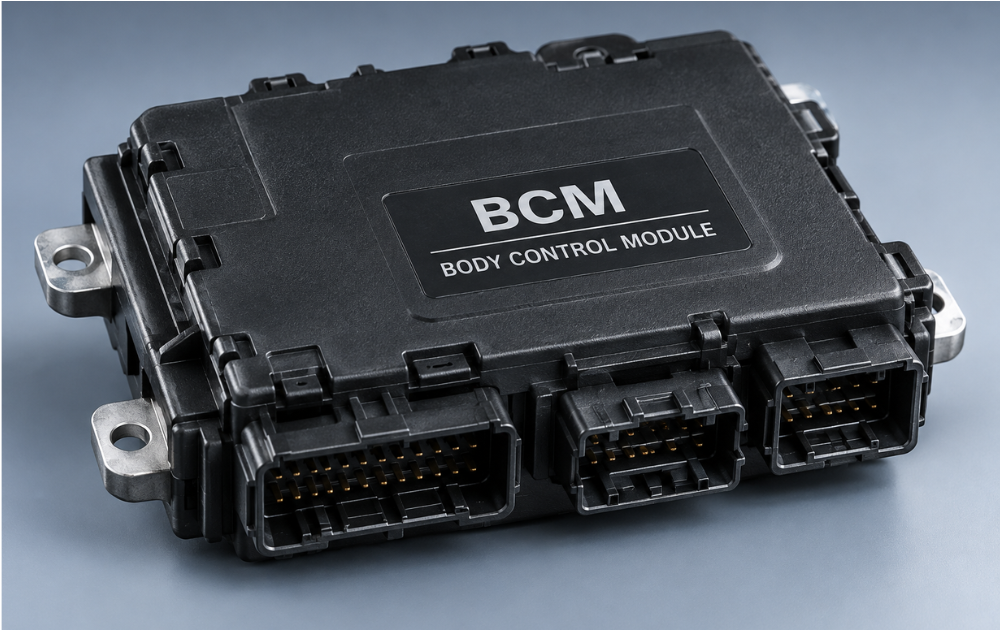
BCM Explained: What Does the Body Control Module Actually Do?
In this article
BCM Explained: What Does the Body Control Module Actually Do?
Modern vehicles contain numerous electronic control modules that work together to operate everything from the engine and transmission to the lights, doors, windows, wipers, and security systems.
One of the most important modules in this electronic architecture is the Body Control Module (BCM).
The BCM manages and coordinates many of the vehicle’s body, comfort, convenience, security, and electrical functions. It receives information from switches, sensors, and other control modules, processes that information, and controls the appropriate systems.
But the BCM is much more than an electronic switchboard. It can also communicate with other modules, monitor electrical circuits, and make decisions based on programmed software.
What Is a BCM?
BCM stands for Body Control Module.
It is an electronic control unit responsible for managing various body-related functions throughout the vehicle.
Depending on the vehicle, the BCM may control or coordinate:
- Exterior and interior lighting
- Power door locks
- Power windows
- Windshield wipers
- Turn signals and hazard lights
- Keyless entry
- Alarm and security functions
- Horn operation
- Mirror functions
- Electrical power management
- Communication with other control modules
The exact functions vary between manufacturers and vehicle models.
Importantly, the BCM does not always control every component directly. In some vehicles, it communicates with separate modules that operate specific systems.
How Does a BCM Work?
The BCM’s operation can be simplified into four stages:
Input → Processing → Communication → Output
Input: Receiving Information
The BCM receives information from sources such as:
- Door switches
- Light switches
- Wiper controls
- Window switches
- Keyless-entry systems
- Sensors
- Other control modules
For example, when a driver presses the lock button on a key fob, the BCM receives the request and determines what action should be performed.
Processing: Making Decisions
The BCM uses its processor and programmed software to evaluate the information it receives.
It can consider multiple conditions before activating a function.
For example, when a door is opened, the BCM can determine whether the interior lights should turn on, how long they should remain active, and whether another module needs to be notified.
Communication: Working With Other Modules
The BCM is part of the vehicle’s electronic network.
Modern vehicles commonly use communication networks such as CAN (Controller Area Network) and LIN (Local Interconnect Network).
Through these networks, the BCM can exchange information with systems such as:
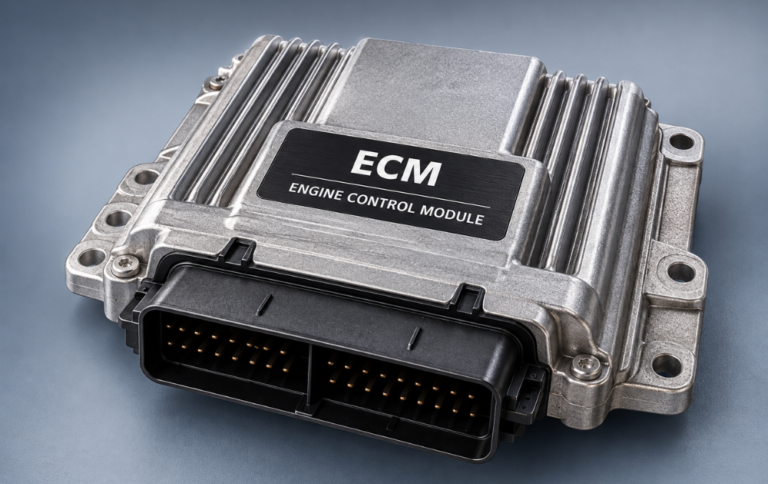
- Engine control systems
- ABS and stability control
- Instrument clusters
- Door modules
- Security systems
- Lighting modules
- Infotainment systems
Output: Controlling Systems
After processing the information, the BCM can activate electrical components or send commands to other modules.
Outputs may include:
- Door-lock actuators
- Lighting circuits
- Wiper systems
- Window systems
- Horn circuits
- Mirror functions
- Other control modules
What Does the BCM Control?
Lighting
The BCM can control or coordinate headlights, parking lights, turn signals, hazard lights, interior lighting, and courtesy lighting.
It may also monitor lighting circuits for electrical faults.
Door Locks and Windows
The BCM can process requests from door switches, key fobs, and keyless-entry systems and coordinate locking and unlocking.
Depending on the vehicle, it may also communicate with door modules responsible for operating power windows and other door functions.
Windshield Wipers
The BCM can process wiper-switch commands and coordinate wiper operation. Some vehicles also use rain sensors and vehicle-speed information to determine the appropriate behavior.
Keyless Entry and Security
The BCM can communicate with keyless-entry, alarm, and immobilizer systems.
This allows the vehicle to coordinate functions such as unlocking doors, activating interior lighting, and responding to security events.
BCM and Power Management
Some BCMs also participate in electrical power management.
Modern vehicles contain many electrical consumers, so the vehicle must control energy usage carefully.
The BCM can participate in functions such as:
- Battery protection
- Load management
- Power distribution
- Sleep and wake-up functions
- Electrical-consumer management
A module or network that fails to enter its normal sleep state can contribute to unexpected battery drain.
Why Can One BCM Problem Cause Many Symptoms?
This is one of the most important things to understand when diagnosing BCM problems.
Because the BCM is connected to many systems, one electrical or communication problem can cause several seemingly unrelated symptoms.
A vehicle might experience:
- Power-lock problems
- Interior-light problems
- Wiper problems
- Remote-key problems
- Communication fault codes
- Battery drain
However, the BCM itself may not be the problem.
Possible causes include:
- Low battery voltage
- Blown fuses
- Poor grounds
- Damaged wiring
- Corroded connectors
- Water intrusion
- Communication-network faults
- Software or configuration problems
- Another faulty module
Multiple symptoms do not automatically mean the BCM has failed.
What Are the Symptoms of a BCM Problem?
Common BCM-related symptoms can include:
- Multiple electrical functions failing
- Power locks not working
- Windows becoming inoperative
- Interior or exterior lighting problems
- Wipers operating incorrectly
- Turn signals malfunctioning
- Keyless-entry problems
- Security-system issues
- Unexpected battery drain
- Multiple communication fault codes
- Intermittent electrical problems
These symptoms should be treated as diagnostic clues rather than proof of a failed BCM.
How Is a BCM Diagnosed?
A proper BCM diagnosis should begin with the vehicle’s basic electrical system.
Technicians may need to:
- Check battery voltage and charging
- Inspect fuses and BCM power supplies
- Test BCM grounds
- Scan the vehicle for DTCs
- Check live data and module status
- Test CAN or LIN communication
- Inspect wiring and connectors
- Perform actuator or output tests
A diagnostic scanner can provide valuable information, but it does not automatically identify the root cause.
A fault code tells you what the system detected—not necessarily which component caused it.
Does a BCM Need Programming?
In many modern vehicles, yes.
A replacement BCM may require:
- Programming
- Coding
- Configuration
- Initialization
- Security-system synchronization
The exact procedure depends on the vehicle.
This means a replacement BCM is not always plug-and-play.
BCM vs. Fuse Box: Are They the Same?
No.
A fuse box primarily provides circuit protection and power distribution.
A BCM is an electronic computer that can process information, communicate with other modules, monitor circuits, and control electrical functions.
Some modern vehicles combine power-distribution components and electronic control functions into the same physical assembly, which can make the two appear similar.
Why Is the BCM Important for Automotive Diagnostics?
Modern vehicles are no longer made up of completely independent electrical circuits.
A single function can involve several components:
Switch → BCM → Communication Network → Module → Actuator
A fault anywhere along this chain can cause the final function to fail.
Therefore, technicians should not simply ask:
“Which part is broken?”
They should also ask:
“Where is the expected power, signal, or communication being lost?”
This approach helps prevent unnecessary parts replacement and leads to more accurate repairs.




One Comment
Comments are closed.