ECM Explained: What Does the Engine Control Module Actually Do?
In this article
ECM Explained: What Does the Engine Control Module Actually Do?
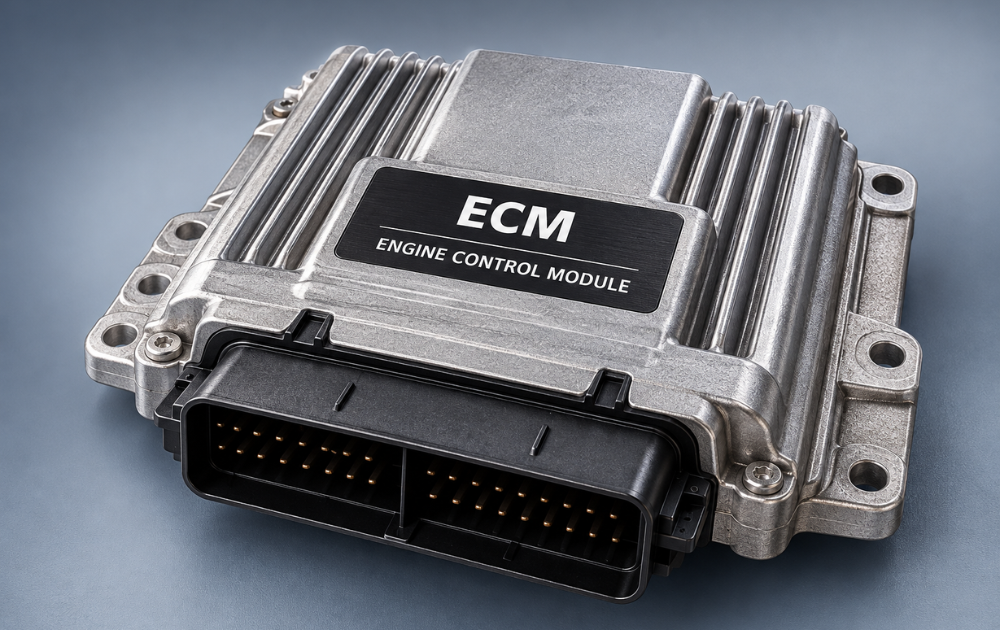
Modern engines rely on sophisticated electronic systems to control fuel delivery, ignition, airflow, emissions, and other critical functions. At the center of this system is the Engine Control Module (ECM).
The ECM continuously receives information from sensors, processes that information using programmed control strategies, and sends commands to engine actuators. This allows the engine to respond to changing conditions while maintaining performance, efficiency, and emissions control.
But how does an ECM actually work? What does it control, and how does it help technicians diagnose engine problems?
In this guide, we will examine the role of the Engine Control Module and its importance in modern engine management and automotive diagnostics.
What Is an ECM?
The Engine Control Module (ECM) is an electronic computer responsible for managing engine operation.
It receives data from sensors throughout the engine and uses that information to determine how different engine systems should operate.
Depending on the vehicle, the ECM can manage functions such as:
- Fuel injection
- Ignition timing
- Electronic throttle control
- Variable valve timing
- Air-fuel mixture
- Emissions control
- Cooling strategies
- Engine protection functions
These decisions are made continuously while the engine is operating.
In simple terms, sensors provide information, the ECM processes it, and actuators carry out the commands.
How Does an ECM Work?
The ECM’s operation can be understood through three basic stages:
Input → Processing → Output
1. Input: Sensors Provide Information
The ECM depends on sensors to determine the engine’s current operating conditions.
Common inputs include:
- Crankshaft position sensor — provides crankshaft position and speed information.
- Camshaft position sensor — provides camshaft position information.
- MAF sensor — measures the mass of incoming air.
- MAP sensor — measures intake manifold pressure.
- Coolant temperature sensor — monitors engine temperature.
- Throttle position sensor — monitors throttle position.
- Oxygen or air-fuel ratio sensors — provide information about combustion and the air-fuel mixture.
- Knock sensor — detects abnormal combustion.
Each sensor provides a specific piece of information. The ECM combines these inputs to determine the engine’s current operating condition.
2. Processing: The ECM Makes Decisions
The ECM’s processor analyzes the incoming sensor data and compares it with programmed control strategies.
For example, when engine load changes, the ECM can evaluate engine speed, airflow, temperature, throttle position, and other parameters before determining the appropriate fuel delivery and ignition strategy.
These calculations happen extremely quickly and are continuously updated as operating conditions change.
3. Output: Actuators Perform the Commands
After processing the available information, the ECM sends electrical commands to actuators that control physical components.
Examples include:
- Fuel injectors
- Ignition coils
- Electronic throttle actuators
- Variable valve timing actuators
- EGR valves
- Turbocharger control systems
- Cooling fan controls
This input-processing-output cycle is repeated continuously while the engine is running.
What Does the ECM Control?
The exact functions vary between vehicles, but the ECM can control several fundamental areas of engine operation.
Fuel Injection
The ECM determines the appropriate amount and timing of fuel delivery based on engine operating conditions.
It uses information from multiple sensors to adjust injector operation as engine speed, load, temperature, and airflow change.
Accurate fuel control is essential for engine performance, fuel economy, and emissions.
Ignition Timing
In gasoline engines, the ECM determines when the ignition system should fire the spark plugs.
Ignition timing can be adjusted according to factors such as engine speed, load, temperature, and combustion conditions.
Incorrect ignition timing can affect performance, efficiency, and engine operation.
Electronic Throttle Control
Modern vehicles commonly use electronic throttle systems.
Instead of a direct mechanical connection between the accelerator pedal and throttle, sensors report pedal position to the ECM. The ECM then determines the appropriate throttle response.
This also allows throttle control to work together with systems such as traction and stability control.
Variable Valve Timing
Many modern engines use variable valve timing to improve efficiency, performance, and emissions.
The ECM can command the valve timing system to adjust camshaft timing according to engine speed, load, and other operating conditions.
Emissions Control
The ECM monitors and controls several systems involved in reducing exhaust emissions.
It uses information from oxygen or air-fuel ratio sensors and other inputs to help maintain appropriate combustion conditions.
Depending on the vehicle, the ECM may also control systems such as EGR and evaporative emissions components.
How Does the ECM Detect Problems?
The ECM continuously monitors sensors, circuits, and engine systems for conditions that fall outside expected operating parameters.
When it detects a fault, it may store a Diagnostic Trouble Code (DTC) and, when the required conditions are met, illuminate the Check Engine Light.
The ECM may also record information about the conditions under which the fault occurred, which can help technicians during diagnosis.
However, a DTC does not necessarily identify the failed component.
For example, a fault code related to an oxygen sensor circuit could be caused by the sensor itself, wiring, an electrical connection, or another condition affecting the signal.
A diagnostic code identifies a detected condition; it does not automatically identify the root cause.
What Happens When the ECM Detects a Fault?
Modern ECMs can use backup strategies when certain faults occur.
If a sensor produces an unreliable signal, the ECM may use an alternative value or control strategy to maintain engine operation.
Depending on the severity of the problem, the vehicle may experience:
- Reduced engine performance
- Poor fuel economy
- Rough running
- Difficulty starting
- Increased emissions
- Warning lights
For certain serious faults, the ECM may activate a fail-safe or reduced-performance strategy, sometimes referred to as limp-home mode.
The response depends on the vehicle and the type of fault detected.
How Does the ECM Communicate With Other Systems?
The ECM is part of the vehicle’s larger electronic architecture.
Modern vehicles contain multiple control modules that exchange information through communication networks such as the Controller Area Network (CAN bus).
The engine control system may exchange information with systems responsible for:
- Transmission control
- Anti-lock braking
- Traction control
- Electronic stability control
- Instrumentation
- Other vehicle systems
This communication allows different systems to coordinate their operation and respond to changing driving conditions.
Can an ECM Be Reprogrammed?
In many modern vehicles, the software stored in the ECM can be updated or reprogrammed.
Manufacturers may release software updates to address issues or improve areas such as:
- Drivability
- Fuel efficiency
- Emissions control
- Diagnostic strategies
- System compatibility
- Reliability
ECM calibration can also be modified for performance applications. However, incorrect calibration can cause drivability problems, increased emissions, or mechanical damage.
What Are the Symptoms of an ECM-Related Problem?
An actual ECM failure can produce a wide range of symptoms, including:
- Engine no-start conditions
- Intermittent stalling
- Poor engine performance
- Multiple unexpected fault codes
- Communication problems with diagnostic equipment
- Loss of communication with other modules
- Unusual warning lights
However, these symptoms do not automatically mean the ECM itself has failed.
Power supply problems, poor grounds, damaged wiring, communication faults, and faulty sensors can produce similar symptoms.
For this reason, technicians should verify the ECM’s power, grounds, wiring, communication circuits, and related systems before condemning the module.
Why Is the ECM Important for Automotive Diagnostics?
The ECM provides technicians with valuable information about engine operation and detected faults.
Using a suitable diagnostic scanner, technicians can access information such as:
- Diagnostic Trouble Codes
- Live sensor data
- Freeze-frame information
- System status
- Readiness information
- Module information
This data can help narrow down the cause of a problem.
However, diagnostic equipment is only one part of the process.
A scanner can show what the ECM has detected, but it does not automatically explain why the problem occurred.
Professional diagnosis may require live-data analysis, electrical testing, physical inspection, wiring checks, and comparison with manufacturer specifications.



One Comment
Comments are closed.