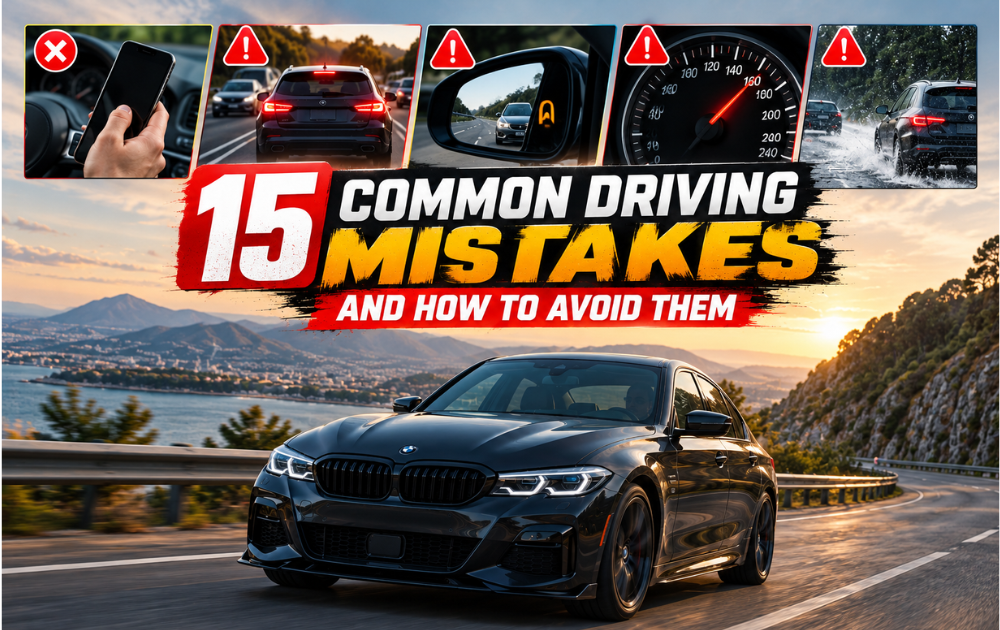
15 Common Driving Mistakes and How to Avoid Them
In this article
15 Common Driving Mistakes and How to Avoid Them
Driving is an everyday activity for millions of people, but even experienced drivers can develop habits that put themselves and others at risk. Small mistakes, such as following another vehicle too closely, failing to check blind spots, or becoming distracted by a mobile phone, can lead to dangerous situations.
Becoming a safer driver does not necessarily require years of experience. It requires awareness, patience, and a good understanding of road safety. By recognizing common driving mistakes and learning how to avoid them, you can improve your driving habits, reduce unnecessary risks, and make every journey safer.
In this article, we explore 15 common driving mistakes and provide practical advice to help you avoid them.
1. Distracted Driving
Distracted driving is one of the most dangerous habits behind the wheel. Using a mobile phone, adjusting navigation settings, eating, or looking away from the road can prevent drivers from reacting quickly to unexpected situations.
Even a brief distraction can be enough to miss a traffic signal, overlook a pedestrian, or fail to notice a vehicle braking ahead.
How to avoid it:
- Put your phone away before starting your journey.
- Set your navigation system and music before driving.
- Avoid eating or performing other distracting activities while the vehicle is moving.
- Keep your attention focused on the road and surrounding traffic.
If you need to make a call, read a message, or adjust something that requires your attention, pull over in a safe, legal location before doing so.
2. Following Other Vehicles Too Closely
Following another vehicle too closely reduces the time available to react when the driver ahead brakes suddenly. This mistake is particularly dangerous at high speeds, in heavy traffic, and on wet or slippery roads.
Many drivers underestimate how much distance they need to stop safely. Even with good brakes, a vehicle cannot stop instantly.
How to avoid it:
- Maintain a safe following distance from the vehicle ahead.
- Use the three-second rule as a basic guideline in good driving conditions, where appropriate.
- Increase the distance when driving in rain, fog, snow, or heavy traffic.
- Leave additional space behind large vehicles if they restrict your visibility.
A safe following distance gives you more time to recognize hazards, react calmly, and reduce your speed without braking suddenly.
3. Ignoring Blind Spots
Blind spots are areas around a vehicle that cannot be seen clearly through the mirrors. Depending on the vehicle, another car, motorcycle, cyclist, or pedestrian may be positioned in one of these areas without the driver realizing it.
Failing to check blind spots before changing lanes or merging can cause dangerous collisions.
How to avoid it:
- Adjust your mirrors properly before driving.
- Check your rearview and side mirrors before changing lanes.
- Briefly look over your shoulder to check the relevant blind spot when safe to do so.
- Use your turn signal before changing direction.
- Avoid changing lanes until you have confirmed that the space is clear.
Mirrors are essential, but they do not show everything. A quick blind-spot check can reveal road users who would otherwise remain unnoticed.
4. Driving Too Fast for Road Conditions
Driving at the posted speed limit does not always mean that your speed is safe. Rain, fog, poor visibility, heavy traffic, sharp curves, and damaged road surfaces can all require you to slow down.
When drivers travel too quickly for the conditions, they have less time to react and may lose control of the vehicle more easily.
How to avoid it:
- Reduce your speed when visibility is limited.
- Slow down before entering sharp curves.
- Adapt your speed to traffic flow and road conditions.
- Increase your following distance when the road is wet or slippery.
- Observe posted speed limits and any temporary restrictions.
Safe driving is not simply about reaching your destination quickly. It is about maintaining control of your vehicle and leaving enough time to respond to unexpected hazards.
5. Using Turn Signals Incorrectly
Turn signals allow other road users to understand your intentions. However, some drivers forget to use them, activate them too late, or leave them on after completing a turn.
These mistakes can confuse other drivers and increase the risk of collisions, especially at intersections and during lane changes.
How to avoid it:
- Signal early enough to give other road users time to react.
- Use your indicators before turning or changing lanes.
- Check mirrors and surrounding traffic before making your maneuver.
- Cancel your signal after completing the maneuver if it does not switch off automatically.
- Remember that signaling does not give you the right of way.
A turn signal communicates your intentions, but you must still make sure that the maneuver is safe before proceeding.
6. Failing to Check Mirrors Regularly
Mirrors provide important information about vehicles approaching from behind, traffic in adjacent lanes, and the space around your vehicle. Drivers who rarely check their mirrors may miss developing hazards or fail to notice changes in traffic.
However, looking at mirrors for too long can also distract you from what is happening ahead.
How to avoid it:
- Check your mirrors regularly while remaining focused on the road ahead.
- Look at your mirrors before braking, turning, or changing lanes.
- Recheck your surroundings when traffic conditions change.
- Combine mirror checks with direct observation when necessary.
Good mirror habits help you maintain awareness of surrounding traffic and make decisions with greater confidence.
7. Braking Too Late
Braking too late can cause sudden stops, reduce vehicle stability, and increase the risk of being hit from behind. This mistake often occurs when drivers fail to anticipate traffic signals, congestion, or changes in the speed of the vehicle ahead.
Sudden braking may sometimes be unavoidable, but many situations can be managed more safely through early observation.
How to avoid it:
- Look well ahead instead of focusing only on the vehicle directly in front of you.
- Anticipate red traffic lights, intersections, and traffic congestion.
- Release the accelerator early when you expect to slow down.
- Apply the brakes smoothly when conditions allow.
- Maintain enough distance to reduce the need for emergency braking.
Anticipating what is happening ahead helps you drive more smoothly and gives other road users more time to respond.
8. Changing Lanes Without Checking Properly
Changing lanes requires more than turning the steering wheel and activating an indicator. Drivers must consider surrounding traffic, blind spots, vehicle speed, and the available space in the destination lane.
Moving into another lane without checking carefully can force other drivers to brake suddenly or cause a collision.
How to avoid it:
- Check your mirrors before changing lanes.
- Signal your intention in advance.
- Check your blind spot when safe to do so.
- Make sure there is enough space to move without forcing another driver to react.
- Change lanes smoothly and avoid unnecessary movements.
Never assume that another driver will slow down or make room for you. Confirm that the lane is clear before moving into it.
9. Underestimating Stopping Distance
Stopping distance is the total distance a vehicle travels between the moment a driver recognizes a hazard and the moment the vehicle comes to a complete stop. It includes reaction distance and braking distance.
Many drivers underestimate how much distance they need, particularly at higher speeds. Wet or slippery roads, worn tires, and poor vehicle condition can increase the distance required to stop.
How to avoid it:
- Maintain a safe following distance.
- Reduce speed when approaching hazards.
- Pay attention to road conditions and visibility.
- Keep your tires and braking system in suitable working condition.
- Avoid assuming that modern safety systems can eliminate stopping distance.
Remember that higher speeds generally require substantially more distance to stop. Leaving enough space can help prevent collisions when traffic suddenly slows.
10. Driving While Tired
Fatigue can reduce concentration, slow reaction times, and affect decision-making. A tired driver may struggle to maintain a consistent speed, overlook road signs, or fail to recognize hazards quickly enough.
In severe cases, drivers may experience microsleeps, which are brief periods of involuntary sleep that can occur without warning.
How to avoid it:
- Get sufficient sleep before a long journey.
- Avoid starting a trip when you feel extremely tired.
- Take regular breaks during extended drives.
- Share the driving when a suitable, rested driver is available.
- Stop somewhere safe if you experience heavy eyelids, repeated yawning, or difficulty concentrating.
Opening a window or turning up the music is not a reliable solution to fatigue. If you are too tired to drive safely, stop and rest before continuing.
11. Using Headlights Incorrectly
Headlights are essential for seeing the road and making your vehicle visible to others. However, incorrect use can reduce visibility or create dangerous glare for oncoming drivers.
Some drivers forget to activate their lights in poor visibility, while others use high beams when approaching vehicles from the opposite direction.
How to avoid it:
- Use your headlights when visibility is reduced or when required by local law.
- Switch to low beams when approaching oncoming traffic or following another vehicle closely.
- Keep your headlights clean and ensure they are functioning correctly.
- Use fog lights only when conditions justify their use and in accordance with local regulations.
- Do not assume that daytime running lights always illuminate your rear lights.
Correct lighting helps you see hazards and allows other road users to recognize your vehicle more easily.
12. Ignoring Road Signs and Markings
Road signs and markings provide essential information about speed limits, priority, lane direction, pedestrian crossings, and potential hazards.
Ignoring them can lead to dangerous decisions, confusion at intersections, and violations of traffic laws.
How to avoid it:
- Pay attention to signs well before reaching them.
- Follow lane markings and directional arrows.
- Observe speed limits and temporary road restrictions.
- Approach unfamiliar intersections carefully.
- Reduce your speed when signs warn of hazards or changing road conditions.
When driving in an unfamiliar area, give yourself enough time to understand the road layout. If you need to check directions, stop somewhere safe rather than trying to study your navigation screen while moving.
13. Merging Onto a Highway Incorrectly
Entering a highway can be challenging because vehicles may already be traveling at high speeds. Merging too slowly, accelerating unpredictably, or moving into a lane without checking for a suitable gap can disrupt traffic and increase collision risks.
Drivers entering the highway must assess the available space and adjust their speed appropriately.
How to avoid it:
- Observe highway traffic while approaching the end of the entrance ramp.
- Use the acceleration lane to build up an appropriate speed when conditions permit.
- Check your mirrors and blind spot.
- Signal before merging.
- Choose a suitable gap and merge smoothly without forcing other drivers to brake suddenly.
Drivers already on the highway should remain alert to merging traffic and adjust their position when it is safe and appropriate. Always follow local road rules, particularly where merging priorities differ.
14. Driving Aggressively
Aggressive driving includes tailgating, excessive speeding, making sudden maneuvers, repeatedly changing lanes without a clear reason, and reacting angrily to other road users.
These behaviors reduce safety margins and can turn minor disagreements into dangerous situations.
How to avoid it:
- Remain patient in heavy traffic.
- Avoid competing with other drivers.
- Leave sufficient space between vehicles.
- Do not respond to provocation with aggressive driving.
- Allow extra time for your journey to reduce pressure and frustration.
You cannot control how other drivers behave, but you can control your own reactions. Staying calm and predictable makes the road safer for everyone.
15. Failing to Adapt to Bad Weather
Rain, fog, strong winds, snow, and icy conditions can make driving more difficult. Wet roads may reduce tire grip, fog can limit visibility, and strong crosswinds can affect vehicle stability.
Drivers who continue at their usual speed without adapting to the weather may have difficulty controlling their vehicles or stopping in time.
How to avoid it:
- Reduce speed when visibility or traction is poor.
- Increase your following distance.
- Avoid sudden acceleration, hard braking, and abrupt steering.
- Use appropriate headlights in poor visibility.
- Make sure your windshield, windows, and mirrors remain clear.
- If conditions become too dangerous, stop in a safe location and wait for them to improve.
If your vehicle begins to lose traction, avoid sudden movements and respond smoothly. Never assume that four-wheel drive or electronic stability control makes it safe to drive quickly on slippery roads.
Additional Tips for Becoming a Safer Driver
Avoiding common mistakes is an important step toward safer driving, but good habits must be maintained consistently. Here are a few additional practices that can help you become a more responsible driver:
- Stay focused: Keep your attention on driving and avoid unnecessary distractions.
- Plan your journey: Check your route and allow enough time to reach your destination without rushing.
- Be predictable: Use your indicators, maintain a steady driving style, and avoid sudden movements whenever possible.
- Respect other road users: Pay particular attention to pedestrians, cyclists, motorcyclists, and children.
- Keep a safe distance: Leave enough room to react when traffic conditions change.
- Follow traffic laws: Observe road signs, speed limits, and local driving regulations.
- Drive according to conditions: Adjust your speed and behavior to match the weather, visibility, and road surface.
- Stay calm: Avoid letting stress, frustration, or pressure influence your decisions behind the wheel.
Safe driving is not about being the fastest or most confident person on the road. It is about recognizing risks, making responsible decisions, and protecting yourself and others.