Why Does My Car Lose Power When Accelerating? Common Causes and Diagnosis
In this article you’ll learn
Why Does My Car Lose Power When Accelerating? Common Causes and Diagnosis
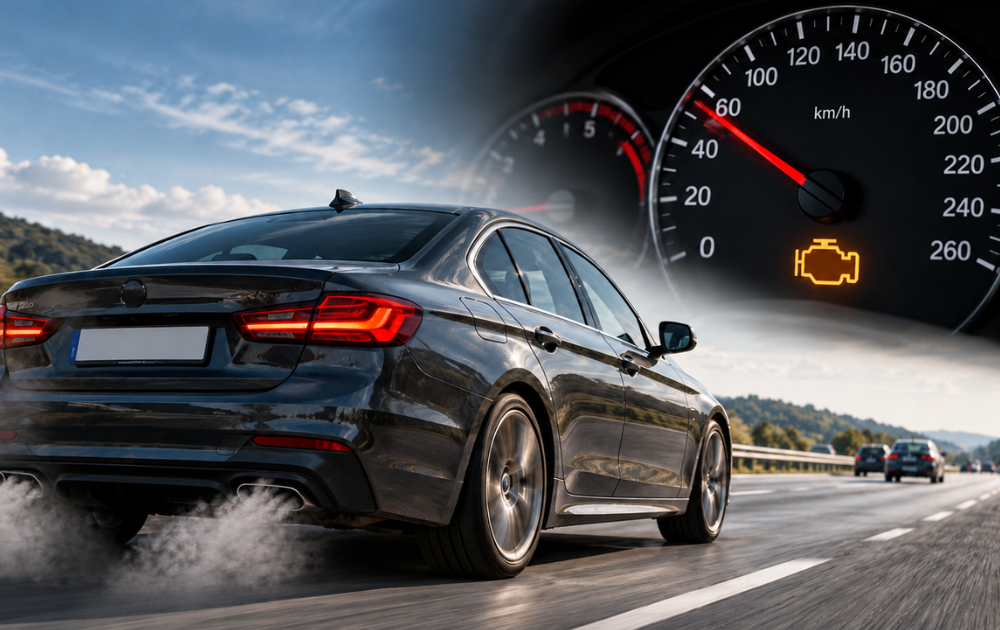
When you press the accelerator pedal, your car should increase speed smoothly. If the engine struggles to accelerate, hesitates, jerks, or suddenly loses power, there may be a problem with the engine, fuel system, air intake, exhaust system, or transmission.
Power loss during acceleration is a common issue in modern vehicles. Sometimes, the cause is relatively simple, such as a clogged air filter or a damaged intake hose. In other cases, the problem may involve a faulty sensor, low fuel pressure, a turbocharger malfunction, or an electronic engine management fault.
Because modern cars rely on electronic control units (ECUs), sensors, and interconnected systems, identifying the actual cause requires a systematic diagnostic approach.
In this guide, we explain the most common reasons a car loses power when accelerating, how to recognize the symptoms, and how to diagnose the problem without unnecessarily replacing expensive components.
1. What Does It Mean When a Car Loses Power During Acceleration?
A car loses power during acceleration when it cannot produce or transmit the expected amount of power in response to the accelerator pedal.
The problem may occur occasionally or become progressively worse. Depending on the underlying fault, you may notice:
- Slow acceleration, even when pressing the accelerator firmly.
- Engine hesitation when increasing speed.
- Jerking or misfiring under acceleration.
- Difficulty climbing hills.
- Reduced power at high engine RPM.
- Poor response when overtaking.
- Increased engine RPM without a corresponding increase in vehicle speed.
- Sudden power reduction accompanied by a warning light.
These symptoms do not all indicate the same problem. For example, an engine that struggles to increase RPM may have a fuel delivery, ignition, air intake, or exhaust problem. However, if engine RPM rises while the vehicle barely accelerates, a slipping clutch or transmission fault may be responsible.
The first step in diagnosing power loss is to determine exactly when the problem occurs and how the engine behaves when it happens.
2. The 10 Most Common Causes of Power Loss When Accelerating
2.1. Fuel Delivery Problems
The engine needs an adequate and consistent fuel supply to produce power. If the fuel system cannot deliver enough fuel during acceleration, engine performance may decrease, particularly when the engine is under heavy load.
Possible causes include:
- A restricted fuel filter, where a serviceable filter is fitted.
- A weak or failing fuel pump.
- Low fuel pressure.
- Restricted or malfunctioning fuel injectors.
- A faulty fuel pressure regulator or control system.
- Contaminated fuel.
Typical symptoms:
- Hesitation when pressing the accelerator.
- Weak acceleration, particularly uphill.
- Power loss at high RPM.
- Engine surging or stalling in some cases.
- Difficulty starting the engine.
How to diagnose it:
Check for relevant diagnostic trouble codes and examine available fuel pressure data. Depending on the vehicle, a technician may need to measure fuel pressure and delivery volume under the conditions that reproduce the fault.
Direct-injection gasoline engines and common-rail diesel engines require particular care because their high-pressure fuel systems operate at potentially dangerous pressures.
Do not replace the fuel pump or injectors simply because the vehicle lacks power. First confirm that the fuel supply, pressure, electrical connections, and relevant control systems are operating correctly.
2.2. Restricted Air Intake or a Dirty Air Filter
The engine needs sufficient clean air for efficient combustion. A heavily restricted air filter, damaged intake duct, or obstruction in the intake system can interfere with airflow.
Although a dirty air filter is easy to check, it is not automatically the cause of every acceleration problem.
Typical symptoms:
- Sluggish acceleration.
- Reduced engine performance.
- Poor response under heavy load.
- An intake restriction visible during inspection.
How to diagnose it:
Inspect the air filter, air intake housing, and intake ducts. Check for obstructions, damaged hoses, loose connections, and other restrictions.
On modern vehicles, also consider whether a faulty airflow sensor or an air leak is causing incorrect engine management calculations.
Replace the air filter if it is excessively dirty or due for replacement according to the manufacturer’s maintenance schedule.
2.3. Faulty MAF or MAP Sensor
Modern engine management systems use sensors to measure or estimate the amount of air entering the engine.
The mass airflow (MAF) sensor measures incoming air mass, while the manifold absolute pressure (MAP) sensor measures pressure in the intake manifold. Depending on the engine design, the ECU uses these readings to manage fuel delivery, ignition timing, and boost control.
Incorrect sensor readings can affect engine performance.
Typical symptoms:
- Slow acceleration.
- Hesitation when pressing the accelerator.
- Unstable engine operation.
- Increased fuel consumption in some cases.
- Check Engine Light.
How to diagnose it:
Connect a compatible diagnostic scanner and inspect relevant fault codes and live-data readings. Compare the measurements with manufacturer specifications under the appropriate operating conditions.
Also inspect sensor wiring, connectors, intake hoses, and possible air leaks.
A MAF- or MAP-related trouble code does not automatically mean the sensor is defective. Wiring problems, intake leaks, contamination, and other engine faults can produce similar results.
2.4. Ignition Misfires in Gasoline Engines
Gasoline engines use spark plugs and ignition coils to ignite the air-fuel mixture. If a spark plug is worn, an ignition coil fails, or an electrical connection becomes unreliable, combustion may become incomplete or intermittent.
This condition is known as an engine misfire.
Typical symptoms:
- Jerking during acceleration.
- Engine vibration.
- Rough idling.
- Reduced engine power.
- A flashing Check Engine Light in some cases.
Misfires may become more noticeable during acceleration because the engine is operating under greater load.
How to diagnose it:
Read the engine ECU’s trouble codes and examine misfire counters where available. Inspect the spark plugs, ignition coils, connectors, and wiring.
If the ignition system appears normal, further testing may be necessary to investigate fuel delivery, compression, or other mechanical problems.
Important: A flashing Check Engine Light accompanied by engine misfires can indicate a risk of catalytic converter damage. Reduce engine load and stop driving as soon as it is safe to do so.
Diesel engines do not use spark plugs for normal combustion, so their diagnostic process differs. Diesel power loss may instead involve fuel injection, compression, boost pressure, or emissions control systems.
2.5. Turbocharger or Boost Pressure Problems
Turbocharged engines use exhaust energy to compress intake air, allowing the engine to produce more power.
If the engine cannot achieve the required boost pressure, acceleration may become noticeably weaker. This is particularly apparent when climbing hills, overtaking, or accelerating at higher engine loads.
Possible causes include:
- A leaking intercooler hose.
- A damaged or disconnected boost pipe.
- A faulty boost pressure sensor.
- A malfunctioning turbocharger actuator.
- A wastegate or variable-geometry turbocharger problem.
- A vacuum leak on systems that use vacuum-controlled components.
- Turbocharger damage.
Typical symptoms:
- Weak acceleration.
- Reduced power under load.
- Underboost or overboost trouble codes.
- Limp mode.
- Unusual hissing or whistling sounds.
- Excessive exhaust smoke in some cases.
How to diagnose it:
Use a suitable diagnostic scanner to compare requested boost pressure with actual boost pressure. Inspect the intake and intercooler pipes, boost sensor readings, actuator operation, and relevant electrical or vacuum circuits.
A turbocharger-related fault code does not prove that the turbocharger must be replaced. A leaking hose, faulty sensor, or control problem may be responsible.
Naturally aspirated engines do not have a turbocharger or turbocharger boost system, so these checks apply only to vehicles equipped with forced induction.
2.6. Clogged DPF or Restricted Exhaust System
The exhaust system must allow combustion gases to leave the engine efficiently. If the exhaust flow becomes restricted, the engine may struggle to produce its normal power.
In diesel vehicles, a diesel particulate filter (DPF), also known as a filtre à particules (FAP), captures soot from exhaust gases. The filter periodically regenerates to burn off accumulated soot.
If regeneration cannot complete successfully or the filter becomes excessively restricted, exhaust backpressure may increase and engine performance may be reduced.
A restricted catalytic converter can also cause power loss in gasoline or diesel vehicles.
Typical symptoms:
- Reduced acceleration.
- Weak performance at higher engine speeds.
- DPF or emissions warning lights.
- Limp mode in some cases.
- Increased fuel consumption under certain conditions.
How to diagnose it:
For a DPF-related problem, inspect relevant fault codes, differential pressure readings, calculated soot loading, exhaust temperature sensor data, and regeneration history.
For suspected exhaust restriction, a technician may need to measure exhaust backpressure or perform other manufacturer-approved tests.
Do not assume that the DPF or catalytic converter itself has failed. A faulty pressure sensor, engine misfire, injector problem, or another underlying fault may be responsible.
Forced regeneration or exhaust component replacement should only be considered after the appropriate diagnostic checks.
2.7. EGR Valve Problems
The exhaust gas recirculation (EGR) system redirects a controlled quantity of exhaust gas into the intake under specific operating conditions to reduce nitrogen oxide emissions.
If the EGR valve sticks, becomes restricted by deposits, or fails to respond correctly, engine performance may be affected.
Typical symptoms:
- Hesitation during acceleration.
- Rough idling.
- Reduced engine power.
- Increased emissions.
- Check Engine Light.
How to diagnose it:
Read relevant fault codes and compare commanded EGR operation with actual position or flow data where available.
Inspect the valve, passages, electrical connections, and control system according to the manufacturer’s procedures.
EGR problems are particularly relevant to many diesel engines, although some gasoline engines also use EGR systems.
2.8. Faulty Accelerator Pedal Sensor or Electronic Throttle Body
Many modern vehicles use an electronic throttle control system. Instead of relying entirely on a mechanical cable, accelerator pedal position sensors communicate the driver’s demand to the ECU.
The ECU then controls the electronic throttle and coordinates engine operation.
If a pedal sensor, throttle body, wiring connection, or related control circuit malfunctions, the engine may not respond correctly.
Typical symptoms:
- Delayed accelerator response.
- Irregular engine response.
- Limited engine speed.
- Electronic throttle or Check Engine warning light.
- Limp mode.
How to diagnose it:
Use a compatible scanner to examine accelerator pedal position, throttle position, relevant fault codes, and sensor signals.
Inspect the wiring, connectors, power supply, and grounds. Follow the manufacturer’s procedures for throttle adaptation or relearning when required.
Because electronic throttle systems are safety-critical, do not replace the pedal sensor or throttle body without confirming the fault.
2.9. Engine Mechanical Problems
Not every loss of power is caused by a sensor or electronic component. Internal engine problems can also reduce performance.
Possible causes include:
- Low cylinder compression.
- Worn piston rings or cylinder damage.
- Valve sealing problems.
- Incorrect valve timing.
- Timing belt or timing chain problems.
- Significant internal engine wear.
These faults may be less common than simple intake or ignition problems, but they are important when initial diagnostic checks fail to identify the cause.
Typical symptoms:
- Persistent loss of power.
- Difficult starting.
- Rough running.
- Unusual engine noises.
- Excessive oil consumption.
- Abnormal exhaust smoke.
- Poor compression readings.
How to diagnose it:
Depending on the symptoms, a technician may perform a compression test, cylinder leak-down test, valve timing inspection, or other mechanical checks.
Mechanical testing is particularly important when the vehicle continues to run poorly despite apparently normal sensor readings and fuel delivery.
2.10. Clutch Slipping or Transmission Problems
Sometimes the engine produces power normally, but the transmission cannot transfer it effectively to the wheels.
In a manual vehicle, a worn clutch may slip under load. In an automatic vehicle, transmission problems may cause slipping, delayed gear engagement, or abnormal gear changes.
Typical symptoms:
- Engine RPM increases without a proportional increase in vehicle speed.
- Weak acceleration despite the engine revving freely.
- Delayed engagement when selecting Drive or Reverse.
- Harsh or irregular gear changes.
- Transmission warning messages.
- A burning smell associated with clutch slip.
How to diagnose it:
Compare engine RPM with vehicle speed and the selected gear. Check for transmission-related fault codes, relevant live data, and signs of clutch slip.
Inspect transmission fluid according to the manufacturer’s procedure where applicable.
If the engine revs freely but the vehicle does not gain speed normally, investigate the drivetrain rather than concentrating exclusively on engine components.
3. Why Does My Car Lose Power Only Under Certain Conditions?
The conditions under which power loss occurs can help narrow down the possible causes.
Power Loss When Accelerating Uphill
Climbing a hill places a greater load on the engine. Possible causes include low fuel pressure, restricted exhaust flow, a boost leak, or another problem that becomes noticeable when the engine requires more power.
Power Loss at High RPM
If the engine loses power at higher RPM, investigate possible fuel delivery restrictions, ignition misfires, airflow problems, boost control faults, or exhaust restrictions.
The cause depends on the engine type and whether the power loss occurs at a particular RPM or under heavy load.
Power Loss When the Engine Is Hot
A fault that appears only after the engine warms up may involve an electrical component that fails when hot, a fuel delivery problem, incorrect temperature-related sensor readings, or another heat-sensitive fault.
Record whether the problem begins after a particular driving period and whether it disappears after the engine cools.
Sudden Power Loss While Driving
Sudden power loss can be caused by an intermittent electrical connection, fuel supply interruption, sensor fault, engine management intervention, or mechanical problem.
If the vehicle becomes difficult to control or cannot maintain a safe speed, stop in a safe location and seek assistance.
Power Loss With Black Smoke From a Diesel Engine
Black smoke can indicate excessive fuel relative to available air or incomplete combustion. Possible causes include boost leaks, airflow measurement problems, injector faults, or EGR-related issues.
The smoke must be interpreted alongside diagnostic codes, live data, and physical inspection.
4. How to Diagnose a Car That Loses Power When Accelerating
A systematic diagnosis is more reliable than replacing parts based on symptoms alone.
Step 1: Confirm the Symptoms
Ask the driver when the power loss occurs and whether it is accompanied by jerking, smoke, warning lights, unusual noises, or changes in engine RPM.
Determine whether the problem occurs during cold starts, after the engine warms up, at high RPM, uphill, or under heavy acceleration.
Step 2: Perform a Visual Inspection
Inspect the air intake, engine wiring, electrical connectors, vacuum hoses where fitted, and turbocharger pipes where applicable.
Look for loose connections, damaged hoses, leaks, and obvious signs of damage.
Check basic maintenance items, including the air filter and service history, where relevant.
Step 3: Read Diagnostic Trouble Codes
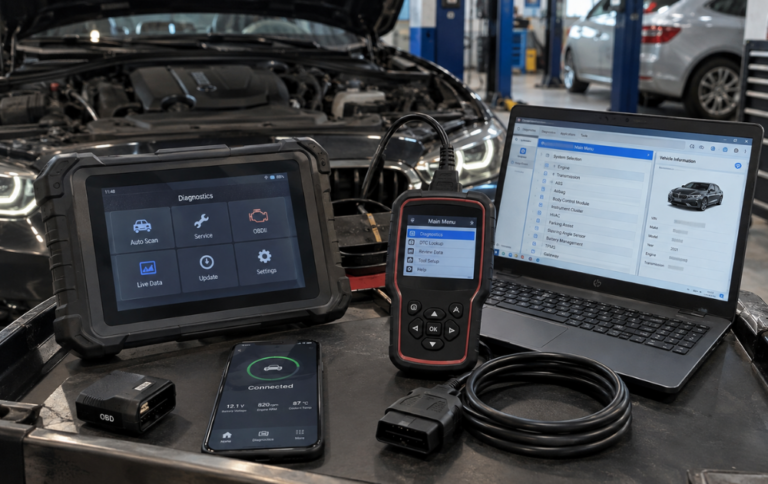
Connect a compatible OBD-II scanner and read stored, pending, and relevant manufacturer-specific fault codes.
Also check other control modules when transmission, electronic throttle, or related systems may be involved.
Record the codes and available freeze-frame data before clearing them.
Remember: A trouble code indicates a detected condition or circuit problem. It does not automatically identify the component that needs replacing.
Step 4: Analyse Live Data
Depending on the vehicle and the symptoms, examine:
- Mass airflow and manifold pressure.
- Accelerator pedal and throttle position.
- Fuel pressure.
- Fuel trims on applicable gasoline engines.
- Misfire counters.
- Requested and actual boost pressure.
- EGR operation.
- DPF differential pressure and regeneration data.
- Engine temperature.
- Engine RPM and vehicle speed.
Compare readings with manufacturer specifications and evaluate them under the conditions in which the fault occurs.
Step 5: Perform Targeted Tests
Use the scan results and initial inspection to decide which tests are necessary.
These may include:
- Fuel pressure and delivery tests.
- Intake smoke testing.
- Ignition system testing.
- Sensor wiring and signal checks.
- Exhaust backpressure testing.
- Turbocharger actuator and boost-system testing.
- Compression testing.
- Clutch or transmission performance checks.
Not every vehicle needs every test. The aim is to identify the most likely system and then confirm the fault.
Step 6: Repair and Verify
Once the cause has been confirmed, repair the faulty component or system according to the manufacturer’s procedures.
Clear codes when appropriate, complete any required adaptations, and verify the repair using relevant live data and a safe road test where necessary.
The original symptom should be checked again to ensure the problem has actually been resolved.
5. Common OBD-II Codes Associated With Power Loss
The following codes may appear when a vehicle loses power during acceleration. They are examples, not a complete diagnostic list.
| OBD-II code | General description | Areas to investigate |
|---|---|---|
| P0101 | Mass airflow sensor range/performance | MAF sensor, intake leaks, wiring, airflow restrictions |
| P0171 | System too lean, Bank 1 | Intake leaks, fuel delivery, airflow measurement |
| P0300 | Random/multiple-cylinder misfire | Ignition, fuel delivery, compression |
| P0299 | Turbocharger/supercharger underboost | Boost leaks, turbo control, sensors, turbocharger |
| P0401 | Insufficient EGR flow | EGR valve, passages, control system |
| P0420 | Catalyst system efficiency below threshold, Bank 1 | Catalytic converter, exhaust leaks, sensor data, underlying faults |
| P0087 | Fuel rail/system pressure too low | Fuel supply, pump, pressure regulation, sensor data |
| P0121 | Throttle/pedal position sensor range/performance | Throttle system, pedal sensor, wiring |
The correct interpretation depends on the vehicle, engine, and manufacturer diagnostic procedures. Some faults may not trigger a specific code, while others may produce several related codes.
Always confirm the suspected cause with appropriate tests before replacing a component.
6. Common Diagnostic Mistakes to Avoid
Replacing parts without confirming the cause can increase repair costs and leave the original problem unresolved.
Avoid these common mistakes:
Replacing the MAF sensor immediately: First inspect the intake system, wiring, connectors, and live airflow data.
Replacing the turbocharger because of an underboost code: Check boost hoses, the intercooler, sensors, and actuator operation first.
Replacing injectors without testing fuel delivery: Confirm fuel pressure and investigate other causes of poor combustion.
Ignoring the transmission: If engine RPM rises without a corresponding increase in vehicle speed, investigate clutch or transmission slip.
Clearing codes before recording them: Save trouble codes and freeze-frame data first, because they can help identify the conditions under which the fault occurred.
Ignoring the underlying cause: A failed catalytic converter or repeated DPF restriction may be the result of another problem, such as persistent misfires, injector faults, or incorrect sensor readings.
A reliable diagnosis combines symptoms, fault codes, live data, physical inspection, and targeted testing.
7. Is It Expensive to Fix a Car That Loses Power?
Repair costs depend on the actual cause, vehicle model, engine type, parts availability, and labour rates.
Some problems, such as a badly clogged air filter or a loose intake hose, may be relatively inexpensive to resolve. Other faults, such as a failed fuel pump, damaged turbocharger, restricted DPF, or internal engine problem, can be significantly more expensive.
Before approving a repair, ask the technician to explain:
- What fault has been identified.
- Which test confirmed the diagnosis.
- Whether other components may have caused the problem.
- What repair is required.
- Whether additional work may be necessary.
It is better to pay for a correct diagnosis than to replace several components without identifying the underlying fault.
8. Can You Continue Driving When Your Car Loses Power?
That depends on the severity of the problem and the symptoms.
A mild, occasional reduction in performance may allow you to move the vehicle to a safe location, but persistent power loss should be investigated promptly.
Stop driving as soon as it is safe and seek professional assistance if you notice:
- Severe or sudden power loss that makes driving unsafe.
- Engine overheating.
- An oil-pressure warning.
- A flashing Check Engine Light accompanied by engine misfires.
- Heavy smoke or a strong fuel smell.
- Loud knocking, grinding, or other unusual mechanical noises.
- A burning smell or signs of an electrical fault.
Do not continue driving if the vehicle cannot maintain a safe speed or respond reliably to the accelerator.
9. How to Prevent Power Loss During Acceleration
Although not every fault can be prevented, regular maintenance can reduce the risk of several common problems.
- Replace filters according to the manufacturer’s schedule.
- Use the correct fuel specification.
- Replace spark plugs at the recommended intervals where applicable.
- Inspect intake and turbocharger hoses for leaks or damage.
- Address warning lights and changes in engine performance promptly.
- Maintain the cooling system and use the recommended engine oil.
- Investigate repeated DPF regeneration problems.
- Repair persistent engine misfires instead of ignoring them.
- Check for applicable manufacturer service information when recurring faults occur.
Preventive maintenance cannot eliminate every failure, but it can help detect developing problems before they become more serious.
Frequently Asked Questions
Why does my car hesitate when I press the accelerator?
Hesitation may result from restricted fuel delivery, an intake leak, incorrect sensor readings, ignition misfires, a boost leak, or an electronic throttle problem. The best starting point is to identify when the hesitation occurs and check for relevant fault codes.
Why does my car lose power but idle normally?
Some faults appear only when the engine requires more fuel or air. Low fuel pressure, boost leaks, ignition misfires under load, and exhaust restrictions may not be obvious while the engine is idling.
Can a bad MAF sensor cause power loss?
Yes. Incorrect airflow measurements can affect engine management and cause hesitation or reduced performance. However, the sensor and its circuit should be tested before replacement.
Why does my diesel car lose power when accelerating?
Possible causes include low fuel pressure, restricted fuel delivery, injector problems, boost leaks, turbocharger control faults, EGR problems, or DPF restriction. Diagnostic data and targeted tests help distinguish between them.
Why does my car rev up but not accelerate?
If engine RPM increases without a proportional increase in vehicle speed, a slipping clutch or transmission problems may be responsible. The drivetrain should be investigated rather than focusing exclusively on the engine.
Can an OBD-II scanner identify the exact cause?
Not always. A scanner provides fault codes and useful live data, but additional electrical, mechanical, or pressure tests may be necessary to confirm the cause.
Does power loss always mean the engine is damaged?
No. Many cases result from fuel delivery, intake, ignition, sensor, turbocharger control, or transmission problems. Internal engine damage is one possibility, but it should not be assumed without supporting evidence.