Car Oil and Filter Change Schedule: A Complete Guide
In this article you’ll learn
Car Oil and Filter Change Schedule: A Complete Guide
Regular oil and filter changes are essential for maintaining engine performance, reducing wear, and extending the life of your vehicle. During everyday driving, engine oil gradually loses its effectiveness, while filters collect dirt and contaminants that can affect engine operation.
Following the correct maintenance schedule helps keep your engine properly lubricated, maintain clean airflow, and protect the fuel system from contamination.
However, not every vehicle requires the same service intervals. The correct schedule depends on the engine type, vehicle model, oil specification, driving conditions, and manufacturer’s recommendations.
In this guide, you will learn when to change engine oil, replace the oil filter, inspect the engine air filter, and service the fuel filter.
1. Engine Oil Change Schedule
Engine oil is essential for the proper operation of an internal combustion engine. It lubricates moving components, reduces friction, helps control heat, and carries contaminants toward the oil filter.
Over time, oil deteriorates because of heat, oxidation, contamination, and normal engine operation. Changing it at the recommended interval helps maintain effective lubrication and reduce premature engine wear.
How Often Should You Change Engine Oil?
The following intervals are general guidelines for planning routine maintenance.
| Engine Oil Type | Illustrative Oil Change Interval |
|---|---|
| Conventional oil | Approximately 5,000–7,500 km |
| Synthetic blend oil | Approximately 7,500–10,000 km |
| Fully synthetic oil | Approximately 10,000–15,000 km |
These intervals are not suitable for every vehicle. Some modern engines allow longer intervals, while certain engines require more frequent oil changes.
Always follow the vehicle manufacturer’s recommended mileage and time limits. Use engine oil that meets the required viscosity and performance specifications for your particular engine.
Why Is Regular Oil Replacement Important?
Old or degraded engine oil may provide less effective protection against friction and wear. It can also accumulate contaminants that affect engine cleanliness.
Regular oil changes help to:
- Maintain proper lubrication of moving engine components.
- Reduce friction and premature wear.
- Support effective engine cooling.
- Help control the accumulation of contaminants.
- Maintain engine reliability and performance.
- Reduce the risk of damage caused by neglected lubrication.
Signs Your Engine Oil Needs Attention
Pay attention to the following warning signs:
- The engine oil level is below the recommended range.
- You notice an oil leak beneath the vehicle.
- The engine develops unusual noises.
- The oil pressure warning light illuminates.
- The vehicle has exceeded its scheduled oil change interval.
Dark engine oil does not automatically mean that it needs immediate replacement. Oil naturally darkens during use. The correct service interval, oil level, vehicle condition, and manufacturer’s recommendations are more reliable indicators.
Important: If the oil pressure warning light illuminates while the engine is running, stop the engine as soon as it is safe to do so. Low oil pressure can cause severe engine damage. Simply adding oil or changing the filter may not resolve the underlying problem.
2. Oil Filter Replacement Schedule
The oil filter is responsible for removing contaminants from the engine oil as it circulates through the lubrication system.
Over time, the filter collects particles and other impurities. Replacing it at the appropriate interval helps maintain effective filtration and protects internal engine components.
When Should You Replace the Oil Filter?
For most vehicles, the recommended practice is to replace the oil filter whenever the engine oil is changed.
For example, if your vehicle requires an oil change every 10,000 km, the oil filter should generally be replaced during that service.
However, the exact interval must follow the manufacturer’s instructions.
Why Should You Change the Oil Filter Regularly?
A properly functioning oil filter helps remove contaminants before they can contribute to engine wear.
Replacing it at the recommended interval helps to:
- Maintain effective oil filtration.
- Reduce the circulation of harmful contaminants.
- Support proper engine lubrication.
- Protect internal engine components.
- Maintain the effectiveness of routine oil service.
A neglected or unsuitable filter may compromise filtration. Always choose a filter that matches the vehicle’s engine specifications.
Should You Change the Oil Filter With Every Oil Change?
In most cases, yes. Replacing the oil filter with the engine oil is a sensible maintenance practice because the old filter contains trapped contaminants.
Installing a new filter during each scheduled oil change helps ensure that the fresh oil circulates through a properly serviced filtration system.
During replacement, the technician should also check for leaks and ensure that the filter is correctly installed.
3. Engine Air Filter Replacement Schedule
The engine air filter prevents dust, dirt, and other airborne particles from entering the engine through the intake system.
Clean air is necessary for proper combustion. If the air filter becomes excessively dirty, airflow may be restricted and engine performance may be affected.
This is particularly important for vehicles driven in dusty environments, on unpaved roads, or in areas with high levels of airborne particles.
How Often Should You Change the Engine Air Filter?
A general planning interval is approximately 15,000–30,000 km, although some vehicles require different intervals.
The correct replacement schedule depends on the engine design, filter type, driving environment, and manufacturer’s recommendations.
If you regularly drive on dusty roads, inspect the filter more frequently.
| Driving Conditions | Recommended Action |
|---|---|
| Normal urban and highway driving | Inspect according to the scheduled service interval |
| Frequent driving on dusty roads | Inspect more frequently |
| Regular driving on unpaved roads | Check for dirt accumulation and restricted airflow |
| Reduced engine performance with a visibly dirty filter | Inspect the intake system and replace the filter if necessary |
Signs of a Dirty Engine Air Filter
A clogged air filter may contribute to the following symptoms:
- Reduced engine performance.
- Restricted airflow through the intake system.
- Increased fuel consumption in some operating conditions.
- Visible dirt or excessive contamination on the filter.
- Engine response that feels different from normal.
These symptoms can also have other causes. A dirty air filter should not automatically be blamed for every performance problem.
Why Is Air Filter Replacement Important?
Replacing the engine air filter when required helps maintain adequate airflow and protects the engine from airborne contaminants.
A clean filter also helps the engine management system maintain the appropriate air-fuel mixture under different operating conditions.
Do not replace the filter unnecessarily at every oil change unless the manufacturer’s schedule or the filter’s condition requires it. Inspect it at the appropriate intervals and replace it when necessary.
4. Fuel Filter Replacement Schedule
The fuel filter removes contaminants from the fuel before they reach sensitive components of the fuel system.
Its role is particularly important in diesel engines, where contamination can affect high-pressure fuel pumps and injectors.
Fuel filter designs and replacement requirements vary considerably between vehicles. Some filters require regular replacement, while others have longer service intervals.
When Should You Replace the Fuel Filter?
The correct interval depends on the vehicle’s make, model, engine, fuel system, and manufacturer’s maintenance schedule.
The following table summarizes the main considerations.
| Vehicle Type | Maintenance Recommendation |
|---|---|
| Petrol vehicles with a replaceable fuel filter | Follow the specified mileage or time interval |
| Petrol vehicles with an in-tank filter | Follow the manufacturer’s inspection and replacement requirements |
| Diesel vehicles with a scheduled fuel filter | Replace it at the specified service interval |
| Vehicles operating in areas with questionable fuel quality | Follow the manufacturer’s guidance and investigate suspected fuel contamination |
There is no single replacement interval that applies to every petrol or diesel vehicle. Some diesel engines require more frequent fuel filter servicing than others.
Signs of a Fuel Filter Problem
A restricted fuel filter may contribute to symptoms such as:
- Difficulty starting the engine.
- Reduced engine power.
- Hesitation during acceleration.
- Engine stalling under certain conditions.
- Poor engine performance under load.
However, these symptoms can also result from fuel pump problems, injector faults, sensor failures, or other mechanical issues.
Proper diagnosis is important before replacing parts.
Why Is Fuel Filter Replacement Important?
Regular fuel filter maintenance helps protect the fuel system from contamination and supports reliable fuel delivery.
Using the correct filter and replacing it according to the manufacturer’s instructions helps reduce the risk of fuel supply problems.
For diesel vehicles, following the specified servicing procedure is especially important. Some fuel systems require priming after filter replacement, and incorrect servicing can introduce air into the system.
5. Complete Oil and Filter Change Schedule
The following table provides a convenient overview of the four main items covered in this guide.
| Component | General Maintenance Interval | Main Purpose |
|---|---|---|
| Engine oil | Approximately 5,000–15,000 km, depending on the vehicle and oil specification | Lubricates the engine and helps control heat |
| Oil filter | Generally replaced with every scheduled oil change | Removes contaminants from engine oil |
| Engine air filter | Often around 15,000–30,000 km, depending on conditions | Prevents airborne particles from entering the engine |
| Fuel filter | According to the vehicle manufacturer’s schedule | Removes contaminants from the fuel |
Important: These figures are general planning guidelines, not universal replacement requirements. Always follow the specified mileage and time intervals for your vehicle.
If the manufacturer recommends an earlier service because of severe driving conditions, follow that schedule.
6. What Is Included in a Routine Oil and Filter Service?
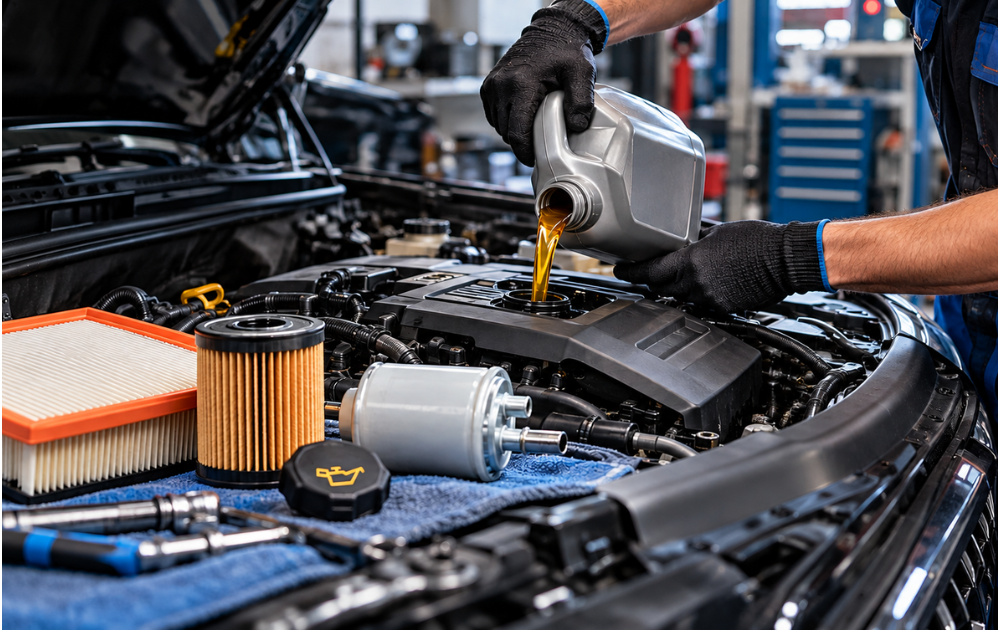
A routine oil and filter service focuses on replacing engine oil and the filters that require maintenance.
Although the exact procedure varies by vehicle, a typical service includes the following steps.
Step 1: Check the Engine Oil Level
Before servicing, the technician checks the oil level and looks for signs of leaks or abnormal oil consumption.
If the level is too low, the cause should be investigated rather than simply ignored.
Step 2: Drain the Used Engine Oil
The used oil is drained using the appropriate procedure for the vehicle.
The technician should follow the manufacturer’s instructions to avoid damage to the drain plug, oil pan, or other components.
Step 3: Replace the Oil Filter
The old oil filter is removed and replaced with the correct filter.
The filter seal and mounting surface should be checked, and the new filter should be installed according to the manufacturer’s instructions.
Step 4: Refill With the Correct Engine Oil
The engine is filled with oil that meets the required specifications.
The technician must use the correct oil viscosity and the appropriate quantity for the engine.
Overfilling and underfilling should both be avoided.
Step 5: Check the Oil Level and Inspect for Leaks
After refilling, the oil level is checked using the procedure specified by the manufacturer.
The engine may be run briefly when appropriate, after which the technician checks for leaks and verifies the oil level again as required.
Any warning lights or abnormal conditions should be investigated.
Step 6: Inspect the Engine Air Filter
The air filter is inspected for excessive dirt, damage, or restriction.
It should be replaced if required by its condition or the manufacturer’s maintenance schedule.
Step 7: Check the Fuel Filter Service Requirement
The technician checks whether the fuel filter is due for replacement.
If replacement is required, the correct filter and servicing procedure must be used for the vehicle’s fuel system.
This approach keeps the service focused on engine oil and filtration rather than replacing components unnecessarily.
7. How Driving Conditions Affect Oil and Filter Changes
Not every vehicle experiences the same operating conditions. Two identical cars can require different maintenance attention depending on how and where they are driven.
Certain conditions can increase engine oil degradation or cause filters to become dirty more quickly.
Frequent Short Trips
Repeated short journeys may prevent the engine from reaching its normal operating temperature for long enough to remove accumulated moisture.
Depending on the engine and operating conditions, this can increase the need for more frequent oil service.
Dusty Environments
Driving on dusty roads exposes the engine air filter to more airborne particles.
In these conditions, regular inspections are particularly important because the filter may become restricted sooner than expected.
Heavy Traffic
Frequent stopping and starting can place additional demands on the engine, especially when combined with short trips and extended idling.
Check whether the manufacturer recommends a shorter oil change interval for this type of use.
Poor Fuel Quality
Fuel contamination can increase the importance of maintaining the fuel filtration system correctly.
If contaminated fuel is suspected, investigate the cause and follow the manufacturer’s recommendations rather than assuming that a routine filter replacement will resolve every problem.
The best approach is to follow the manufacturer’s normal or severe-service schedule according to your actual driving conditions.
8. Common Mistakes to Avoid During Oil and Filter Service
Even a routine oil and filter change can cause problems if it is performed incorrectly.
Avoid these common mistakes:
Using the wrong engine oil
The oil must meet the viscosity and performance requirements specified for the engine. Choosing oil based only on its price or viscosity can lead to an unsuitable product being used.
Ignoring the oil filter
Installing fresh oil while leaving an overdue oil filter in place is generally not recommended. Replace the filter according to the specified service procedure.
Overfilling the engine with oil
Too much oil can cause operating problems and, in some engines, serious damage. Always use the correct quantity and verify the level.
Installing the wrong filter
Oil, air, and fuel filters are not interchangeable. Even filters that appear similar may have different dimensions, filtration characteristics, or installation requirements.
Replacing every filter at the same interval
The oil filter, engine air filter, and fuel filter do not necessarily share the same replacement schedule. Follow the individual requirements for each component.
Ignoring warning lights
An oil pressure warning, significant oil leak, or persistent engine problem should not be treated as a routine maintenance reminder. Investigate the underlying cause promptly.
Disposing of used oil incorrectly
Used engine oil must be collected and disposed of through an appropriate waste management or recycling facility. Never pour it into drains, onto the ground, or into waterways.
9. Frequently Asked Questions
How Often Should I Change My Engine Oil?
The interval depends on your vehicle, engine, oil specification, and driving conditions. Some vehicles require relatively short intervals, while others permit longer periods between changes. Always consult the manufacturer’s service schedule.
Should I Replace the Oil Filter Every Time I Change the Oil?
For most vehicles, yes. Replacing the oil filter during each scheduled oil change is generally recommended unless the manufacturer specifies otherwise.
How Often Should I Replace My Engine Air Filter?
Many vehicles have illustrative replacement intervals around 15,000–30,000 km, but the correct interval varies. Vehicles driven in dusty environments may need more frequent inspections and earlier replacement.
Do Petrol and Diesel Vehicles Use the Same Fuel Filter?
No. Fuel filter designs and service requirements differ between petrol and diesel vehicles. Always use the correct filter for the engine and fuel system.
Can a Dirty Air Filter Increase Fuel Consumption?
A severely restricted air filter can affect engine operation. However, the effect on fuel consumption depends on the engine design and operating conditions. Increased fuel consumption can also have many other causes.
Can I Change My Engine Oil Without Replacing the Air Filter?
Yes. The engine air filter does not normally need to be replaced at every oil change. Inspect it according to the maintenance schedule and replace it when required.
Does a Car Need an Oil Change Even If It Is Rarely Driven?
Yes. Engine oil can deteriorate over time, even when the vehicle covers relatively few kilometres. Follow both the mileage-based and time-based service intervals specified by the manufacturer.
How Do I Know Which Oil and Filters My Car Needs?
Check the owner’s manual or the manufacturer’s service information for the correct oil specifications, oil capacity, and compatible filter part numbers. Vehicle registration details alone may not be sufficient if several engine variants are available for the same model.