How to Tell if Your Car Battery Is Going Bad
What you’ll learn
How to Tell if Your Car Battery Is Going Bad
Is your car slow to start, making a clicking sound when you turn the key, or needing frequent jump-starts? These are common signs that your car battery may be losing its ability to hold and deliver power. However, a weak battery is not always the cause. Problems with the alternator, starter, battery terminals, or another part of the electrical system can produce similar symptoms.
Learning how to tell if your car battery is going bad can help you identify the problem before you end up with a vehicle that will not start.
In this guide, we will cover the most common warning signs of a failing battery, explain how to test battery voltage with a multimeter, and show you how to distinguish a battery problem from a charging-system problem.
1. The Engine Cranks Slowly
A slow engine crank is one of the most common warning signs of a weak battery.
When you start the car, the starter motor should turn the engine over quickly and consistently. If the engine sounds noticeably slower than usual, the battery may not be delivering enough current to the starter.
You may notice that:
- The engine takes longer to start.
- The starter sounds weaker or slower than usual.
- The engine cranks several times before starting.
- Starting becomes more difficult after the car has been sitting overnight.
- The problem is more noticeable in cold weather.
A slow crank does not automatically mean the battery has failed. Loose battery cables, corroded terminals, a worn starter motor, or a charging-system problem can cause similar symptoms.
2. The Car Makes a Clicking Sound When Starting
If you turn the key or press the start button and hear repeated clicking instead of the engine turning over, the battery should be one of the first things you check.
Starting the engine requires a significant amount of electrical current. If the battery cannot provide enough power, the starter solenoid may repeatedly engage and disengage, creating a rapid clicking sound.
However, clicking is not conclusive proof of a bad battery. A poor electrical connection or a faulty starter or starter solenoid can produce similar symptoms.
For that reason, testing the battery and inspecting the connections is more reliable than diagnosing the problem by sound alone.
3. The Battery Warning Light Stays On
If the battery-shaped warning light appears on the dashboard while the engine is running, do not immediately assume that the battery itself is defective.
This warning light commonly indicates a problem with the vehicle’s charging system.
Possible causes include:
- A failing alternator
- A damaged or loose serpentine belt
- Poor battery connections
- Damaged wiring
- A faulty voltage regulator
- A weak or defective battery
If the warning light remains on while driving, the charging system should be checked as soon as possible. If the alternator is not charging the battery correctly, the vehicle may eventually lose electrical power and stop running.
4. The Headlights or Electrical Accessories Become Weak
Changes in electrical performance can also be a warning sign.
Depending on the vehicle and the underlying problem, you may notice:
- Headlights that appear dimmer than normal
- Interior lights becoming weaker
- Power windows operating more slowly
- Dashboard lights flickering
- The radio or infotainment system restarting
- Electrical accessories behaving inconsistently
These symptoms can be caused by a weak battery, but they can also point to an alternator, wiring, or connection problem.
Think of them as warning signs that the electrical system needs to be checked rather than proof that the battery needs to be replaced.
5. You Frequently Need a Jump-Start
If you have had to jump-start your car several times recently, there is likely an underlying problem that needs attention.
A battery that repeatedly goes dead may be:
- Too old to hold a charge properly
- Internally damaged
- Being drained by an electrical fault
- Not receiving enough charge from the alternator
Pay attention to what happens after the jump-start.
If the car starts normally after receiving a jump but becomes difficult to start again after sitting overnight, the battery may not be holding its charge.
However, replacing the battery without finding the underlying cause can lead to the same problem with the new battery. The alternator and electrical system should also be checked.
6. The Battery Case Is Swollen, Cracked, or Leaking
A visual inspection can reveal signs of serious battery damage.
A normal battery case should have a solid, intact shape. If you notice that the case is swollen, cracked, leaking, or otherwise damaged, the battery should not be ignored.
Battery swelling can be associated with excessive heat, overcharging, freezing conditions, or internal battery failure.
Do not attempt to open, repair, or continue using a severely damaged battery. Have it inspected and replaced safely.
7. There Is Corrosion Around the Battery Terminals
Open the hood and inspect the battery terminals and cable connections.
White, blue, or greenish deposits around the terminals are signs of corrosion. Heavy corrosion can increase electrical resistance and interfere with the connection between the battery and the vehicle.
This can cause:
- Difficult starting
- Slow engine cranking
- Intermittent electrical problems
- Poor charging
- No-start conditions
Corrosion does not necessarily mean the battery itself has failed. If the battery is otherwise healthy, cleaning the terminals and restoring a secure connection may solve the problem.
If corrosion is severe or returns quickly, the battery and charging system should be inspected to determine why it is occurring.
8. The Battery Is Several Years Old
Car batteries have a limited service life, and their lifespan depends on several factors.
Climate, driving habits, battery quality, vehicle design, and the condition of the charging system can all affect battery life.
Frequent short trips can be particularly demanding because the alternator may not have enough time to replace the energy used during starting. High temperatures can also accelerate battery deterioration.
If your battery is several years old and you are beginning to experience starting problems, having it tested is a sensible preventative step.
Battery age alone does not mean the battery has failed. However, an older battery is more likely to have reduced starting capacity.
How to Test a Car Battery With a Multimeter
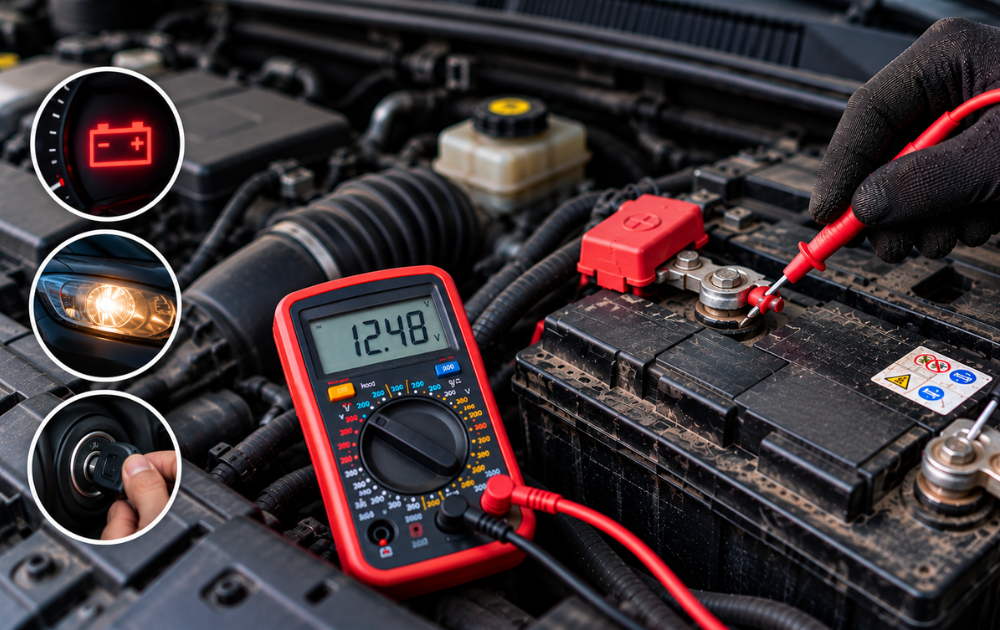
A digital multimeter can provide a useful first check of a 12-volt automotive battery.
Before testing, turn off the engine and all electrical accessories. If possible, allow the vehicle to sit for a while before taking the measurement.
Set the multimeter to DC voltage and connect the probes as follows:
- Red probe → Positive (+) battery terminal
- Black probe → Negative (-) battery terminal
A fully charged conventional 12-volt automotive battery will typically measure around 12.6 volts with the engine off.
As a general guide:
| Battery Voltage | Approximate State of Charge |
|---|---|
| Around 12.6 V | Fully charged |
| Around 12.4 V | Partially charged |
| Around 12.2 V | Significantly discharged |
| Below 12.0 V | Very low charge |
These readings can help determine the battery’s approximate state of charge, but they cannot prove that the battery is healthy.
A battery may show a reasonable resting voltage and still be unable to provide enough current to start the engine. A proper load or conductance test can provide a better assessment of the battery’s actual condition.
Perform a Cranking Voltage Test
Testing the battery while the engine is being started can provide additional information.
Connect the multimeter to the battery terminals and have someone start the vehicle while you watch the voltage reading.
The voltage will naturally drop while the starter is operating. What matters is whether it drops excessively or the starter turns unusually slowly.
A significant voltage drop can indicate that the battery is weak or that there is excessive resistance somewhere in the starting circuit.
However, the result should be considered alongside the battery’s condition, temperature, cable connections, and starter performance. A proper battery tester is preferable when an accurate diagnosis is required.
Check the Charging System
If the engine starts, the next step is to check whether the vehicle is charging the battery correctly.
With the engine running, measure the voltage across the battery terminals.
On many conventional vehicles, charging voltage will be higher than the battery’s resting voltage and may commonly fall somewhere around 13.5 to 14.8 volts. However, this is not a universal specification.
Modern vehicles can use intelligent charging systems that intentionally vary alternator output depending on operating conditions. Because of this, a single voltage reading should not automatically be treated as a pass-or-fail test.
If the charging voltage appears abnormal, the alternator, wiring, battery connections, and charging-control system may require further diagnosis.
Battery vs. Alternator: What’s the Difference?
Battery and alternator problems are often confused because they can produce similar symptoms.
The battery stores electrical energy and provides the high current needed to start the engine. The alternator generates electrical power while the engine is running and helps recharge the battery.
In simple terms:
Battery → Provides the power needed to start the engine
Alternator → Produces electrical power while the engine is running and recharges the battery
If the car struggles to start but operates normally once running, the battery may be the problem.
If the car starts after a jump but the battery repeatedly becomes discharged, the charging system should also be tested.
The key is to diagnose the entire starting and charging system instead of replacing parts based on symptoms alone.
Can a Bad Battery Cause a Check Engine Light?
A weak battery can sometimes contribute to electrical or electronic issues.
If system voltage becomes unusually low, some vehicle control modules may behave unexpectedly or store temporary fault codes.
However, you should not automatically assume that a check engine light is caused by the battery.
If the check engine light is illuminated, use an OBD2 scanner to read the stored diagnostic trouble codes. The codes and other diagnostic information should then be used to identify the actual cause.
When Should You Replace the Battery?
Battery replacement may be necessary when the battery:
- Fails a proper battery test
- Cannot hold a charge
- Has significant internal damage
- Has a swollen, cracked, or leaking case
- Consistently causes weak starting performance
- Has reached the end of its service life and is showing signs of deterioration
Before installing a new battery, make sure the battery terminals and charging system are also checked.
A new battery will not solve the problem if the alternator is failing or an electrical fault is repeatedly draining the battery.