Car Diagnostic Test Machine: How It Works and What It Can Test
Car Diagnostic Test Machine: What It Does, How It Works, and How to Choose One
Modern cars contain dozens of electronic control systems that constantly monitor sensors, actuators, and vehicle functions. When something goes wrong, a car diagnostic test machine can communicate with these systems and provide information that helps identify the source of the problem.
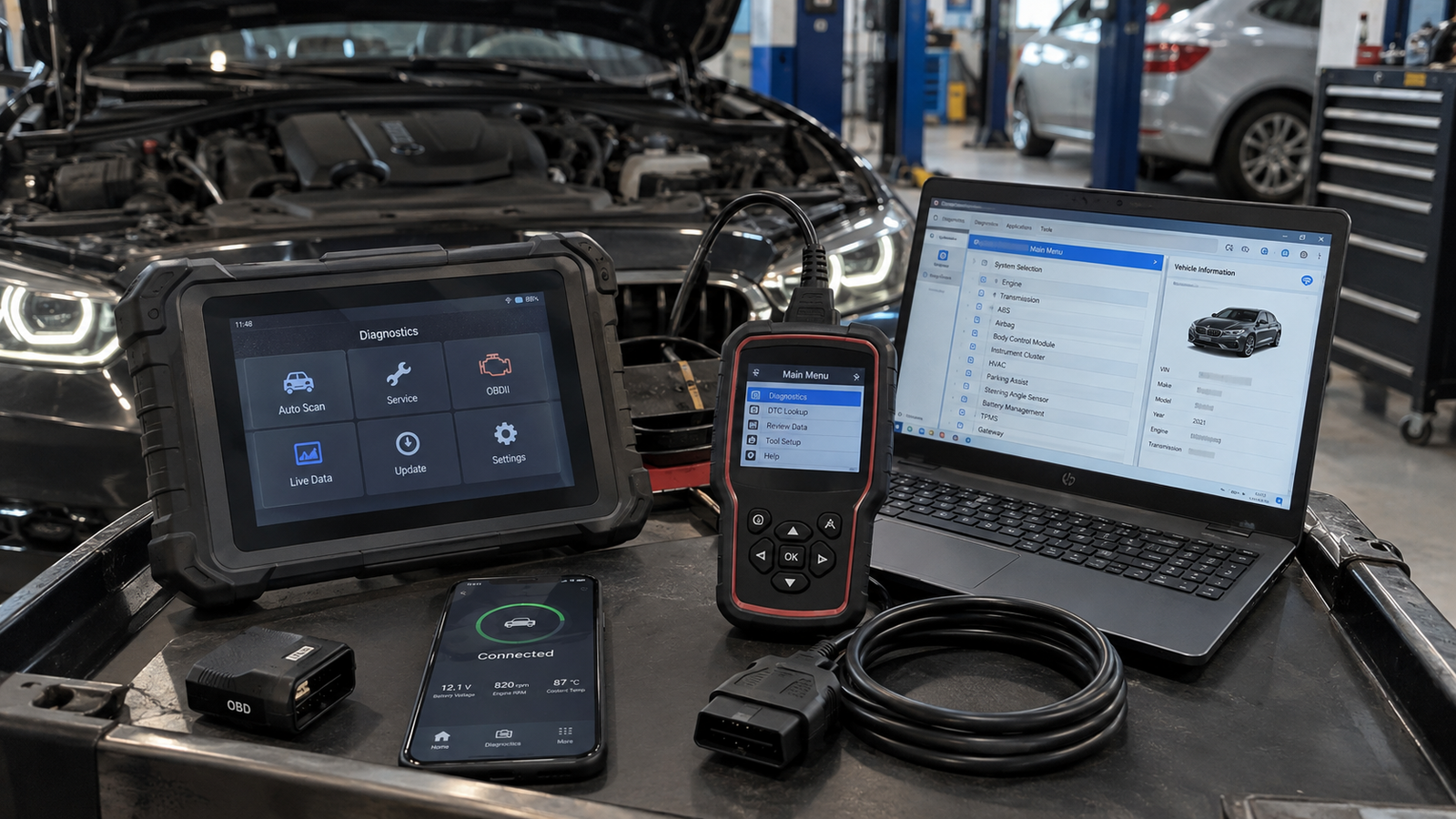
A diagnostic test machine is more than a code reader. Depending on the machine, it can scan multiple control modules, display live data, perform system tests, activate components, carry out service procedures, and sometimes perform coding or programming.
For workshops and automotive technicians, choosing the right diagnostic machine means looking beyond the screen and the number of functions advertised. Vehicle coverage, system access, testing capabilities, software, and technical support all matter.
What Is a Car Diagnostic Test Machine?
A car diagnostic test machine is professional equipment used to communicate with a vehicle’s electronic control units (ECUs) and perform diagnostic tests.
It typically connects to the vehicle through the diagnostic connector and communicates with systems such as:
- Engine
- Transmission
- ABS
- Airbag/SRS
- Body control module
- Steering
- HVAC
- Parking brake
- TPMS
- Instrument cluster
- Other electronic modules
The machine retrieves information from the vehicle and allows the technician to analyze faults and system behavior.
Depending on the machine, it may also be able to send commands to certain vehicle components and perform specific service procedures.
What Can a Car Diagnostic Test Machine Do?
The exact capabilities depend on the machine and the vehicle, but professional equipment can provide several important diagnostic functions.
1. Read Diagnostic Trouble Codes
One of the basic functions is reading Diagnostic Trouble Codes (DTCs) stored in the vehicle’s control modules.
A code can indicate that a particular system has detected an abnormal condition.
For example:
P0301 — Cylinder 1 Misfire Detected
The code provides useful information, but it does not automatically mean that the ignition coil, spark plug, or injector is defective.
The technician still needs to determine the actual cause.
2. Clear Fault Codes
A diagnostic machine can usually clear stored fault codes after a repair or diagnostic procedure.
However, clearing a code is not the same as repairing the fault.
If the problem still exists, the control module may detect it again and store a new fault code.
For this reason, fault codes should normally be cleared after the cause of the problem has been investigated or repaired, not simply to switch off a warning light.
3. Perform a Full Vehicle Scan
A professional diagnostic machine can scan several control modules in one operation.
Instead of checking only the engine ECU, a full scan may include:
- Engine
- Transmission
- ABS
- Airbag
- Body control
- Steering
- HVAC
- Instrument cluster
- Parking brake
- TPMS
- Other available modules
This is useful when a vehicle has multiple warning lights or an electrical communication problem.
4. View Live Data
Live data is one of the most useful functions for diagnosing modern vehicles.
The machine can display information reported by sensors and control modules while the vehicle is operating.
Depending on the vehicle, this may include:
- Engine RPM
- Coolant temperature
- Intake air temperature
- Throttle position
- Airflow
- Fuel trims
- Oxygen sensor values
- Vehicle speed
- Battery voltage
- Fuel pressure
- Boost pressure
- Sensor status
Instead of only asking “What fault code is stored?”, the technician can ask:
“What is the system actually doing right now?”
This can make live data extremely useful when investigating intermittent or performance-related problems.
Active Tests and Bi-Directional Controls
More advanced diagnostic machines can perform active tests, also known as bi-directional controls.
With this function, the machine can send commands to a supported control module and observe the response.
Depending on the vehicle, the technician may be able to activate components such as:
- Cooling fans
- Fuel pumps
- Relays
- Solenoids
- Valves
- Actuators
- Other electronically controlled components
For example, instead of waiting for a cooling fan to activate naturally, a compatible diagnostic machine may allow the technician to command the fan to turn on and check whether it operates.
This can help separate a control problem from a component or wiring problem.
Important: Active tests are vehicle-specific. A machine supporting bi-directional control does not mean that every component can be activated on every vehicle.
Service Functions
Professional diagnostic machines can also provide service and maintenance functions.
Depending on the vehicle and machine, these may include:
- Oil service reset
- Battery registration
- Electronic parking brake service
- Steering angle calibration
- Throttle relearn
- DPF service functions
- Injector coding
- Transmission adaptations
- Suspension calibration
- TPMS procedures
- Service interval reset
These functions can save time compared with manual procedures, but the exact process depends on the vehicle.
Coding, Adaptations, and Programming
Some advanced diagnostic machines provide access to more complex functions such as coding, adaptations, or programming.
These functions are not the same thing.
Coding
Coding generally involves configuring a control module or vehicle feature according to specific parameters.
Adaptations
Adaptations allow a control module to learn or adjust certain values or component characteristics.
Programming
Programming can involve updating or writing software to a control module.
These functions require more care than simply reading a fault code. An incorrect procedure or interruption during programming can create additional problems.
Always verify vehicle compatibility and follow the appropriate manufacturer or tool instructions.
Diagnostic Test Machine vs. Basic OBD2 Scanner
The two terms are sometimes used interchangeably, but they can represent very different types of equipment.
| Feature | Basic OBD2 Scanner | Diagnostic Test Machine |
|---|---|---|
| Engine fault codes | ✓ | ✓ |
| Clear codes | ✓ | ✓ |
| Basic live data | ✓ | ✓ |
| Full-system scan | Limited | ✓ |
| ABS diagnostics | Limited/No | Often ✓ |
| Airbag diagnostics | Limited/No | Often ✓ |
| Transmission diagnostics | Limited/No | Often ✓ |
| Advanced live data | Limited | ✓ |
| Active tests | Usually No | Often ✓ |
| Service functions | Limited | ✓ |
| Coding/adaptations | Usually No | Some machines ✓ |
| Programming | Usually No | Some advanced platforms ✓ |
The important difference is diagnostic depth, not simply the physical size of the machine.
How Does a Diagnostic Test Machine Work?
The general process is straightforward.
Step 1: Connect the Machine
Connect the diagnostic interface to the vehicle’s diagnostic connector.
Step 2: Identify the Vehicle
Enter or automatically identify the following vehicle information, where supported:
- Manufacturer
- Model
- Year
- Engine
- VIN
Step 3: Select the Diagnostic Function
Depending on the problem, the technician may choose:
- Auto scan
- Control module
- Fault codes
- Live data
- Active test
- Service function
Step 4: Perform the Test
The machine communicates with the relevant control module and retrieves or exchanges diagnostic information.
Step 5: Analyze the Results
The technician compares the results with expected values and other available diagnostic information.
Step 6: Confirm the Fault
Additional testing may be necessary before replacing a component.
Step 7: Repair and Verify
After the repair, the vehicle should be tested again to confirm that the original problem has been resolved.
Can a Diagnostic Test Machine Find the Exact Fault?
Not by itself.
This is one of the most important things to understand about automotive diagnostics.
A diagnostic machine can tell you what the vehicle has detected, but it does not always identify the failed component.
For example, a fault related to an engine sensor could be caused by:
- The sensor itself
- Damaged wiring
- A poor electrical connection
- A power supply problem
- A ground problem
- A mechanical problem
- Another component affecting the system
A professional diagnosis combines scan information with physical inspection and appropriate testing.
The machine is a diagnostic instrument, not a replacement for diagnostic reasoning.
What Should You Look for in a Diagnostic Test Machine?
If you’re buying equipment for professional automotive diagnostics, consider the following.
Vehicle Coverage
Check whether the machine supports the exact vehicles you work on.
Don’t rely solely on the number of brands advertised.
Check:
- Vehicle models
- Model years
- Engines
- Control modules
- Special functions
System Coverage
A machine may support a vehicle but still provide limited access to certain systems.
Check whether it supports the systems you actually need:
Engine → Transmission → ABS → SRS → Body → Steering → HVAC → TPMS → ADAS
Diagnostic Functions
Look beyond basic code reading.
Depending on your work, you may need:
- Live data
- Full-system scanning
- Active tests
- Service functions
- Adaptations
- Coding
- Programming
Software Updates
Vehicle technology changes continuously, so software support is important.
Before purchasing a machine, check:
- Update frequency
- Included update period
- Subscription requirements
- Cost after the included period
- New vehicle coverage
- Added diagnostic functions
The initial purchase price isn’t always the total cost of ownership.
Hardware Quality
A professional diagnostic machine may be used for many hours every day.
Consider:
- Screen quality
- Battery life
- Processing speed
- Storage
- Wireless connectivity
- Cable quality
- Durability
- Charging
- Vehicle communication interface
A machine that is powerful but inconvenient to use can slow down the diagnostic process.
Common Mistakes When Choosing a Diagnostic Machine
Choosing Based Only on Price
The cheapest machine may not provide the coverage required for your vehicles.
At the same time, buying the most expensive machine available isn’t automatically necessary.
The important question is:
Does the machine provide the functions and coverage you actually need?
Choosing Based on the Number of Functions
A machine advertising hundreds of functions may sound impressive, but those functions are only useful if they work on the vehicles you diagnose.
Always verify the actual coverage.
Ignoring Subscription Costs
Some diagnostic platforms require paid software updates or subscriptions.
Consider the long-term cost before purchasing.
Assuming “Full System” Means Everything
Terms such as full system, bi-directional, coding, and programming can mean different things depending on the manufacturer.
Check exactly what is supported for your vehicles.
Who Needs a Diagnostic Test Machine?
Car Owners
A basic scanner may be enough for simple engine fault-code checks.
DIY Mechanics
A mid-range diagnostic tool with broader system coverage can be useful for more advanced troubleshooting.
Automotive Technicians
A professional diagnostic machine becomes increasingly valuable when working with multiple vehicle systems and performing advanced tests.
Professional Workshops
Workshops generally need to consider vehicle coverage, diagnostic functions, software updates, technical information, and support before choosing their equipment.
Diagnostic Machine + Other Testing Equipment
A scan tool is only one part of a professional diagnostic setup.
Depending on the fault, technicians may also need:
- Digital multimeter
- Oscilloscope
- Battery tester
- Smoke machine
- Compression tester
- Fuel pressure tester
- Vacuum gauge
- Current clamp
- Pressure transducers
For example, a diagnostic machine may indicate a sensor-related fault, while a multimeter or oscilloscope can help determine whether the sensor, wiring, power supply, or signal is actually responsible.
Good diagnostics often require more than one testing method.