What Is a Software-Defined Vehicle? How Software Is Changing Modern Cars
In this article
What Is a Software-Defined Vehicle?
A Software-Defined Vehicle (SDV) is a vehicle where software plays a central role in determining how different vehicle systems operate and what features the vehicle can provide.
Traditional vehicles generally rely on many individual electronic control units, commonly known as ECUs. Each ECU is responsible for specific functions, such as engine management, transmission control, airbags, climate control, lighting, or other electronic systems.
Modern software-defined vehicles are moving toward more centralized and powerful computing architectures.
Instead of relying entirely on many separate controllers, some newer vehicles use fewer but more powerful computers that can manage multiple functions.
This approach can make it easier for manufacturers to update software, introduce new features, improve vehicle systems, and manage increasingly complex electronic functions.
In simple terms:
Traditional vehicle:
Hardware determines most of the vehicle’s functions.
Software-defined vehicle:
Hardware and software work together, while software has a much greater influence on the vehicle’s capabilities.
This does not mean that hardware is becoming unimportant.
Brakes, suspension, steering components, batteries, electric motors, sensors, wiring, and other physical components remain essential.
The difference is that software is becoming a much more important layer that connects, controls, and manages these components.
How Do Software-Defined Vehicles Work?
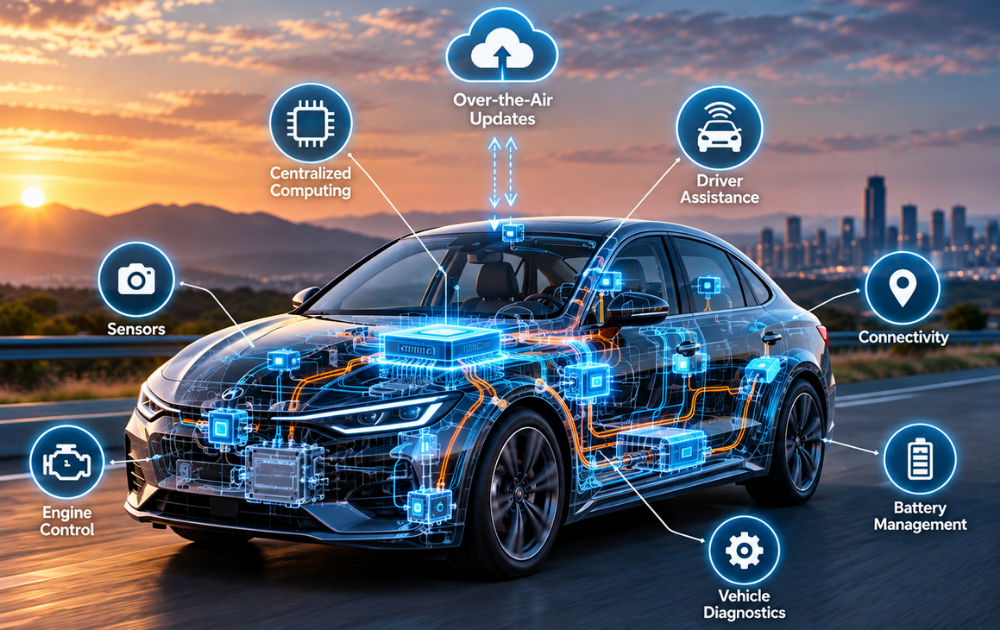
A software-defined vehicle depends on multiple technologies working together.
These can include:
- Electronic Control Units
- Central vehicle computers
- Sensors
- Vehicle communication networks
- Operating systems
- Embedded software
- Cloud connectivity
- Artificial intelligence
- Over-the-air updates
- Diagnostic systems
Together, these technologies create a highly connected digital platform inside the vehicle.
Electronic Control Units
Electronic Control Units have been used in vehicles for many years.
An ECU receives information from sensors, processes that information, and sends commands to different vehicle components.
For example, an engine control unit may receive information about engine temperature, throttle position, air pressure, engine speed, and other parameters before adjusting engine operation.
Modern vehicles can contain numerous electronic controllers, which can make the vehicle’s electronic architecture increasingly complex.
Software-defined vehicles aim to simplify and centralize some of this architecture.
Centralized Computing
One of the major developments associated with software-defined vehicles is centralized computing.
Instead of having separate controllers for almost every individual function, powerful computers can manage multiple systems.
This can reduce certain types of electronic complexity and make software management easier.
It can also provide more computing power for advanced applications such as artificial intelligence, driver assistance, connected services, and advanced diagnostics.
Sensors
Software needs information to make decisions.
Modern vehicles therefore use many different types of sensors, including:
- Cameras
- Radar
- Ultrasonic sensors
- Wheel-speed sensors
- Temperature sensors
- Pressure sensors
- Position sensors
- Battery sensors
These sensors provide information that vehicle software can analyze.
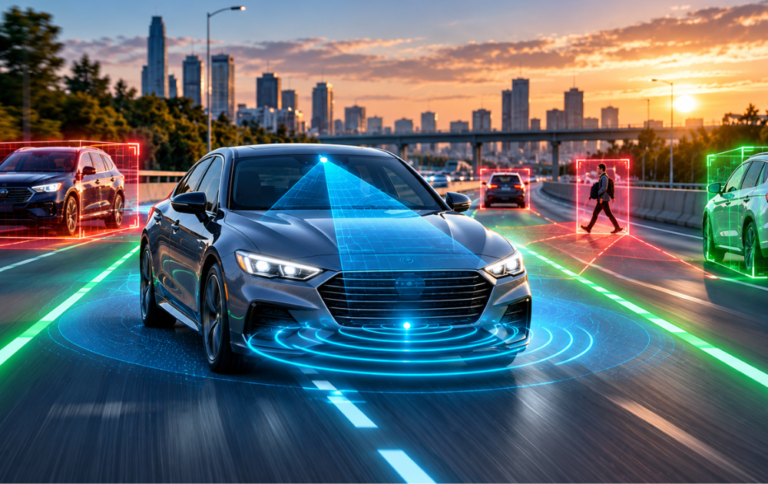
For example, an advanced driver-assistance system can combine information from cameras and radar to understand what is happening around the vehicle.
What Can Software Control in a Modern Car?
Software can influence a large number of vehicle functions.
Depending on the vehicle, software can manage or control systems such as:
- Engine and powertrain functions
- Battery management
- Charging
- Driver assistance
- Infotainment
- Navigation
- Climate control
- Vehicle displays
- Connectivity
- Lighting
- Security systems
- Diagnostics
Let’s look at some of these areas in more detail.
Engine and Powertrain Functions
Modern engine management systems use software to control fuel injection, ignition, emissions systems, air intake, and many other parameters.
Electric vehicles rely heavily on software to manage electric motors, battery systems, charging, and energy usage.
Battery Management
Electric vehicles depend heavily on software for battery management.
A Battery Management System (BMS) can monitor parameters such as:
- Battery temperature
- Voltage
- Current
- State of charge
- Cell conditions
- Charging behavior
This information helps the vehicle manage battery performance and protect the battery system.
Driver Assistance
Software plays a major role in modern Advanced Driver Assistance Systems (ADAS).
These systems can include:
- Adaptive cruise control
- Lane-keeping assistance
- Automatic emergency braking
- Blind-spot monitoring
- Traffic-sign recognition
- Parking assistance
The software processes information from different sensors and uses it to assist the driver.
Infotainment
Software also controls many features that drivers interact with every day.
These can include:
- Navigation
- Music
- Smartphone integration
- Voice assistants
- Digital displays
- Applications
- Connected services
Modern infotainment systems are increasingly similar to computer platforms rather than traditional car entertainment systems.
What Are Over-the-Air Updates?
One of the most important technologies associated with software-defined vehicles is Over-the-Air (OTA) updating.
OTA updates allow manufacturers to send software updates to supported vehicle systems through a wireless connection.
For additional information on vehicle software updates, see the UNECE UN Regulation No. 156 on software update management.
This means that certain updates can be installed without requiring the vehicle owner to visit a dealership or repair shop.
OTA updates can potentially be used to:
- Fix software problems
- Improve vehicle performance
- Update infotainment systems
- Improve driver-assistance functions
- Install security updates
- Improve charging systems
- Add or modify certain software features
This represents a significant change from traditional vehicle ownership.
In the past, a vehicle’s capabilities were largely determined when the vehicle was manufactured and delivered.
With OTA updates, certain aspects of a vehicle can continue to evolve after purchase.
Can an OTA Update Fix a Car Problem?
Sometimes, yes.
If a problem is caused by software, an update may be able to correct it.
For example, a software update could potentially address:
- Incorrect sensor processing
- Communication problems between modules
- Infotainment bugs
- Charging-management issues
- Driver-assistance software problems
- Electronic control problems
However, an OTA update cannot physically repair damaged hardware.
If a vehicle has a damaged sensor, broken wiring, worn brake components, a failed battery cell, or a mechanical problem, a software update cannot physically repair the problem.
The basic distinction is:
Software problem → May be solved with software
Hardware or mechanical problem → Usually requires physical diagnosis and repair
Some problems can involve both hardware and software, which is why modern automotive diagnostics increasingly requires knowledge of both areas.
How Software-Defined Vehicles Are Changing Car Diagnostics
This is one of the most important changes for automotive technicians.
Traditional diagnostics often involves:
- Connecting a diagnostic scanner
- Reading fault codes
- Checking live data
- Testing components
- Identifying the cause
- Repairing or replacing the component
- Clearing fault codes
Modern vehicles still require these procedures, but software is making diagnostics increasingly complex.
A technician may now need to investigate:
- ECU communication
- Software versions
- Network communication
- Sensor data
- Module configuration
- Security access
- Calibration
- Software faults
- Programming requirements
- Live vehicle data
A diagnostic trouble code does not always mean that the component mentioned by the code is physically defective.
For example, a communication fault could be caused by:
- Wiring problems
- Network problems
- Power supply issues
- Software problems
- Module configuration
- Faulty sensors
- Another control module
This means that advanced diagnostic equipment and technician knowledge are becoming increasingly important.
The Growing Importance of Advanced Diagnostic Tools
As vehicles become more software-driven, basic code readers may not be sufficient for every diagnostic situation.
Professional diagnostic tools can provide access to functions such as:
- Full-system scanning
- Live data
- Active tests
- Service functions
- Module identification
- ECU coding
- Adaptations
- System resets
- Battery registration
- Some programming functions
- Advanced vehicle communication
The exact capabilities depend on the vehicle, diagnostic equipment, software, and manufacturer access.
For technicians, the evolution toward software-defined vehicles means diagnostic equipment is becoming more than a simple fault-code reader.
Modern diagnostic tools are increasingly becoming an interface between the technician and the vehicle’s electronic architecture.
What Is Secure Gateway Access?
Modern vehicles are also becoming more security-focused.
Some manufacturers use secure gateway systems to control access to certain vehicle functions.
A secure gateway can restrict diagnostic commands that could affect important vehicle systems.
As a result, technicians may sometimes require authorized access or compatible diagnostic equipment to perform certain operations.
This means that having the correct physical diagnostic connector does not necessarily provide unrestricted access to every electronic function.
As vehicles become more connected, diagnostic access, cybersecurity, and software authentication are becoming increasingly important parts of automotive repair.
Software-Defined Vehicles and Artificial Intelligence
Artificial intelligence is another major technology influencing modern vehicles.
AI can be used for applications such as:
- Driver assistance
- Object recognition
- Voice interaction
- Predictive maintenance
- Personalized vehicle functions
- Data analysis
- Autonomous driving development
AI and software-defined vehicle technology are closely connected because advanced AI systems require significant computing power and access to large amounts of data.
AI could also become increasingly useful for vehicle diagnostics.
Instead of simply displaying a fault code, future diagnostic systems could analyze:
- Fault codes
- Live data
- Sensor behavior
- Vehicle history
- Previous repairs
- Operating conditions
and help technicians identify possible causes more efficiently.
However, AI-based diagnostic assistance should complement proper testing rather than replace professional verification.
Software-Defined Vehicles and Predictive Maintenance
Traditional vehicle maintenance is often based on time or mileage.
For example:
Change the engine oil every 10,000 miles.
Predictive maintenance takes a different approach.
Instead of relying only on mileage, vehicle systems can analyze information from sensors and electronic systems to identify patterns that could indicate a developing problem.
Potential parameters include:
- Battery condition
- Temperature
- Vibration
- Voltage
- Pressure
- Component performance
- Driving behavior
The goal is to identify potential problems earlier and help determine when maintenance may actually be required.
As vehicle software becomes more advanced, predictive maintenance could become an increasingly important part of vehicle diagnostics.
How Are SDVs Different From Traditional Cars?
| Traditional Vehicles | Software-Defined Vehicles |
|---|---|
| More hardware-focused | More software-focused |
| Many dedicated controllers | Greater use of centralized computing |
| Features are largely fixed at production | Some features can evolve through updates |
| Diagnostics often focus heavily on hardware | Diagnostics increasingly combine hardware and software |
| Updates may require a service visit | Some updates can happen over the air |
| Limited connectivity | Greater connectivity |
| Less software evolution after purchase | Greater potential for continuous software development |
The transition is not completely binary.
Many vehicles today are somewhere between traditional electronic architectures and fully software-defined vehicles.
Automakers are gradually introducing centralized computing, connected systems, OTA updates, and software-based functions.
What Are the Benefits of Software-Defined Vehicles?
1. Remote Software Updates
Manufacturers can update supported vehicle systems without requiring every software update to be performed at a service center.
2. Continuous Improvements
Software can potentially improve certain vehicle functions throughout the vehicle’s lifetime.
3. Faster Feature Development
Software-based features can be developed and improved through updates.
4. Advanced Diagnostics
More vehicle data can provide additional information when investigating problems.
5. Better Connectivity
Software-defined vehicles can communicate with cloud services, mobile applications, and other connected systems.
6. Advanced Driver Assistance
Powerful computing and software can support increasingly sophisticated driver-assistance systems.
7. More Flexible Vehicle Architecture
Centralized computing can provide a more flexible platform for managing multiple vehicle systems.
What Are the Challenges of Software-Defined Vehicles?
Software-defined vehicles also introduce new challenges.
Cybersecurity
Connected vehicles can have more digital systems that need to be protected against unauthorized access.
Manufacturers therefore need strong cybersecurity measures and secure software-update processes.
Software Complexity
More software can also mean more potential bugs, compatibility issues, and software-related faults.
Diagnostic Complexity
Technicians need to understand increasingly complex electronic systems, networks, software, and security procedures.
Dependence on Connectivity
Some connected functions depend on communication between the vehicle, cloud services, and other systems.
Long-Term Software Support
A vehicle can remain on the road for many years.
This raises an important question:
How long should manufacturers continue supporting the software of an older vehicle?
This could become increasingly important as vehicles become more dependent on software.
Will Software Replace Traditional Car Repairs?
No.
Software-defined vehicles will not eliminate the need for mechanical repairs.
Cars will still contain physical components that wear out, become damaged, or require replacement.
These include:
- Tires
- Brake pads
- Brake discs
- Suspension components
- Steering components
- Bearings
- Cooling systems
- Body components
- Wiring
- Batteries
- Electric motors
- Mechanical components
What is changing is the relationship between mechanical repair and electronic diagnosis.
A technician may increasingly need to understand both.
For example, a warning light could be caused by:
Mechanical problem → Electrical problem → Sensor problem → Communication problem → Software problem
Finding the real cause requires proper diagnostic procedures rather than simply replacing the component associated with a fault code.
What Does This Mean for Mechanics?
The role of the automotive technician is changing.
Modern technicians increasingly need knowledge in areas such as:
- Automotive electronics
- OBD diagnostics
- CAN bus systems
- ECU communication
- Live data analysis
- ADAS
- EV systems
- Battery diagnostics
- Software updates
- Coding and programming
- Cybersecurity
- Diagnostic equipment
This does not mean traditional mechanical skills are becoming irrelevant.
Instead, modern automotive repair increasingly combines:
Mechanical Knowledge + Electrical Knowledge + Diagnostic Skills + Software Knowledge
This combination is becoming increasingly important as vehicles become more computerized.
What Does This Mean for Car Owners?
For drivers, software-defined vehicles can offer several advantages.
A vehicle may receive software improvements after purchase.
Certain software-related problems may be resolved remotely.
New software features may become available.
Diagnostics can potentially become more advanced.
However, owners should understand that modern vehicle maintenance is no longer only about oil changes and mechanical components.
Software updates, electronic systems, cybersecurity, battery management, recalls, and diagnostic information can also become part of vehicle ownership.
Are Electric Vehicles Driving the SDV Trend?
Electric vehicles are strongly associated with the development of software-defined vehicles.
There are several reasons for this.
Electric vehicles already rely heavily on software for:
- Battery management
- Charging
- Motor control
- Energy management
- Thermal management
- Regenerative braking
- Driver assistance
However, software-defined technology is not limited to electric vehicles.
Manufacturers are also developing increasingly software-driven architectures for gasoline, hybrid, and other types of vehicles.
The automotive industry is therefore moving toward a future where software becomes increasingly important regardless of the vehicle’s powertrain.
What Is the Future of Software-Defined Vehicles?
The automotive industry is moving toward vehicles that behave more like connected computing platforms.
Future developments could include:
- More centralized vehicle computers
- More advanced OTA updates
- Greater use of artificial intelligence
- Improved predictive maintenance
- More sophisticated ADAS
- More advanced EV battery management
- Greater vehicle connectivity
- More software-based features
- Improved diagnostic systems
- Greater integration between vehicles and cloud services
Autonomous driving is also closely connected to this transformation.
As computing power, sensors, AI, and vehicle software continue to improve, vehicles can become increasingly capable of understanding their surroundings and assisting drivers.
However, the capabilities available to drivers will continue to vary depending on the vehicle, manufacturer, software, hardware, regulations, and market.
How Software Is Changing the Automotive Industry
The transition to software-defined vehicles is affecting almost every part of the automotive industry.
Vehicle Manufacturers
Manufacturers increasingly need software-development capabilities alongside traditional automotive engineering.
Diagnostic Technicians
Technicians need to understand electronic systems, communication networks, software, and advanced diagnostic equipment.
Repair Shops
Independent repair shops may need new tools, training, software access, and technical information to work effectively on increasingly computerized vehicles.
Car Owners
Drivers are becoming more dependent on software updates, electronic systems, connectivity, and digital vehicle features.
Diagnostic Tool Manufacturers
Diagnostic equipment is evolving from simple code readers into increasingly advanced systems capable of interacting with complex vehicle networks and electronic modules.
Software-Defined Vehicles Are Changing Car Diagnostics
One of the biggest consequences of this transformation is the changing nature of vehicle diagnostics.
A modern technician cannot always diagnose a problem by looking only at the mechanical component.
Instead, the technician may need to examine the entire chain:
Sensor → Wiring → Network → ECU → Software → Vehicle Function
A problem anywhere in this chain can affect the final result.
This is why modern diagnostic work increasingly requires a combination of knowledge, testing, and appropriate diagnostic equipment.
The future technician may spend less time simply asking:
“Which part is broken?”
and more time asking:
“Why is the vehicle’s system behaving this way?”
That difference is important.
Modern diagnostics is increasingly about understanding how multiple systems communicate and work together.